Detained Without a Bond Hearing: Federal Habeas Corpus in 2026
Index
- What the July 8, 2025 DHS Memo Actually Did
- Matter of Yajure Hurtado and the BIA's Endorsement
- Reading § 1226 and § 1225 Together
- Four Reasons the Interior Is Different
- The Laken Riley Act: A Congressional Signal
- What Six Federal Courts Just Decided
- The Circuits That Rejected the DHS Reading
- The Circuits That Agreed with DHS
- The First Circuit and What Is Coming
- The Federal Habeas Petition: How It Works
- The Alternative Path: Prolonged Detention Claims
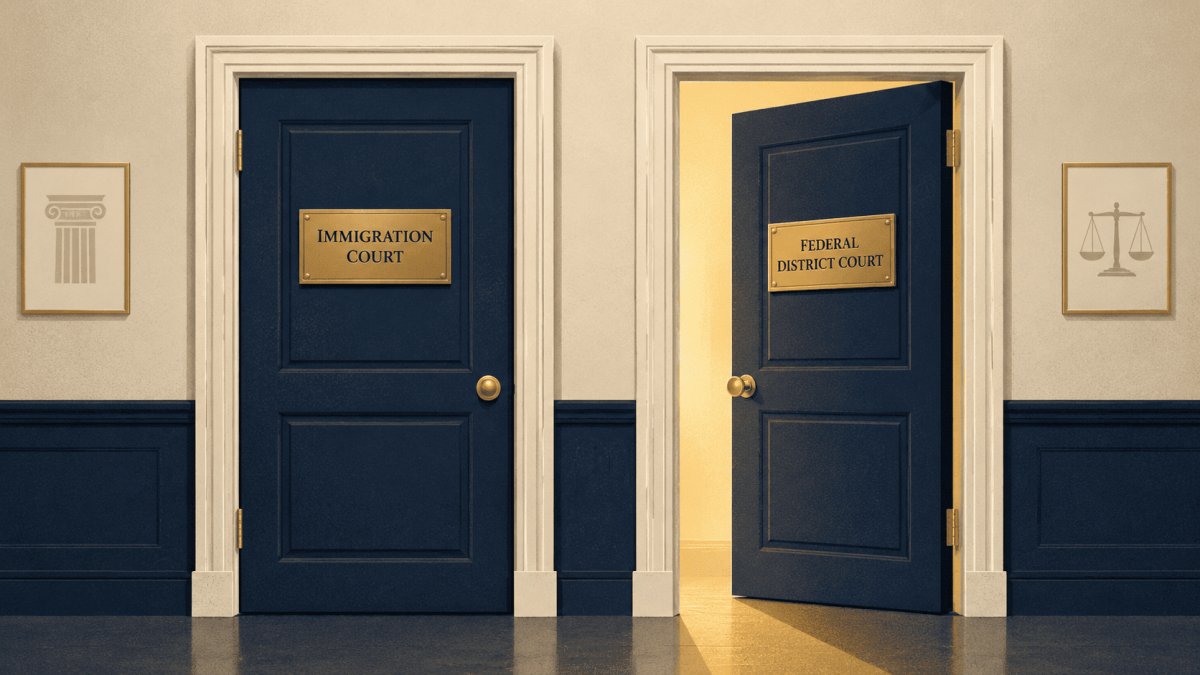
- When the immigration court closes the door, federal court opens one.
- Sources and Further Reading
The judge looked down at the file and shook her head. "I do not have jurisdiction to grant bond in this case." The room went quiet. A husband who came to the United States in 2004, married a citizen, raised two kids, and never missed an ICE check-in was going back to detention. His only opening now runs through federal court.
Something changed in July 2025. DHS sent Immigration and Customs Enforcement an unpublished memorandum instructing officers to detain every person who entered without inspection under 8 U.S.C. § 1225(b)(2), a statute Congress wrote for people arriving at the border. Thirty years of settled practice reversed in a single administrative move. Immigration judges began denying bond hearings on jurisdictional grounds, and thousands of long-term residents lost their forum inside immigration court.
The response has been the largest wave of federal habeas litigation in immigration law in a generation. Between March and May 2026, six federal courts of appeals ruled on whether the DHS position holds up, and four of them said it does not. This article walks through what the memo did, what the Board of Immigration Appeals said next in Matter of Yajure Hurtado, how six circuits divided, and what happens when a lawyer files a habeas petition in federal district court. If your case is stuck at a different stage, our guide to filing a mandamus lawsuit covers the parallel remedy. For families dealing with detention today, the pages that follow map the door that has not yet closed.
What the July 8, 2025 DHS Memo Actually Did
For thirty years, the practice was straightforward. Someone who came into the country without inspection and had been living here for a while, if picked up by ICE, ended up in removal proceedings under section 240 of the Immigration and Nationality Act. That person could ask the immigration judge for a bond, and the judge had the power to grant it. The statute providing this framework is 8 U.S.C. § 1226(a). That was the settled rule until the summer of 2025.
On July 8, 2025, DHS issued unpublished guidance to ICE that changed the framing. The memo instructed ICE to detain applicants for admission, including those who entered without inspection, under 8 U.S.C. § 1225(b)(2) instead. That section requires mandatory detention. No immigration judge bond hearing. No individualized assessment of flight risk or danger. Nothing.
The memo was not published in the Federal Register. It did not go through notice and comment. It bypassed the usual administrative rulemaking process altogether. And it applied to people who had been living in the country for years, in some cases decades. The reinterpretation was retroactive by design, sweeping in long-term residents whose lives had been built on the older rule.
A relative who might have been released on bond within days under the old practice was now held indefinitely, sometimes hours from home, in a detention facility that might be full and understaffed. Family visits became difficult. Attorney access became difficult. Case preparation became difficult.
Matter of Yajure Hurtado and the BIA's Endorsement
Once DHS announced the new position, the Board of Immigration Appeals moved to give it doctrinal backing. In Matter of Yajure Hurtado, 29 I&N Dec. 216 (BIA 2025), the Board held that 8 U.S.C. § 1225(b)(2) applies to everyone who entered without inspection. The reasoning was compact: an applicant for admission is anyone seeking admission, and anyone who entered without inspection is technically an applicant for admission because they never went through a lawful admission process. Two statutory phrases collapsed into one.
The Board's ruling gave immigration judges cover to deny bond hearings in every EWI case that came before them. Judges were told they lacked jurisdiction to consider release. Some judges disagreed on the record. A handful wrote decisions expressing skepticism about the DHS position. But the practical outcome was fixed: no bond hearing in immigration court, regardless of how long the person had been in the country.
Family ties did not matter. Employment history did not matter. Clean criminal records did not matter. The only fact that counted was the manner of entry, sometimes decades before, sometimes when the detained person was still a child. The message to families was blunt: if you want a bond hearing, take it to federal court.
Thousands of families found themselves in exactly that position. Detention facilities filled. Federal district court dockets filled with habeas petitions. Immigration attorneys who had never filed a federal court pleading learned to file one. Solo practitioners partnered with federal litigators. Nonprofit legal services organizations retooled. The habeas practice that had once been a specialized corner of immigration law became the mainstream.
Reading § 1226 and § 1225 Together
Congress wrote two different detention statutes for two different situations. That distinction matters, and it is why the administration's reading breaks down when you look at the text. The two sections sit in different subchapters, address different scenarios, and were meant to operate side by side, not one on top of the other. Understanding the two rules is the foundation of every habeas petition in this space.
Section 1226(a) governs the detention of people already inside the country whose immigration case is being decided in immigration court. It provides a general right to a bond hearing before an immigration judge. There are exceptions listed in section 1226(c), but those exceptions are specific and limited: people with certain criminal convictions, terrorism-related grounds, and, after the Laken Riley Act of 2025, EWIs with certain crime-based inadmissibility findings. Section 1226(c) does not include EWIs as a general category.
Section 1225(b)(2) governs a different situation. It applies to people the government determines are "seeking admission or lawful entry into the United States." The Supreme Court described the reach of section 1225 in Jennings v. Rodriguez as operating "at the Nation's borders and ports of entry, where the Government must determine whether a noncitizen seeking to enter the country is admissible." The provision was written for arrival, not for someone whose life in this country is a decade old. Border and interior are not the same place, and the statute never pretended they were.
| Feature | Section 1226(a) | Section 1225(b)(2) |
|---|---|---|
| Applies to | People already in the country in removal proceedings | People seeking admission at borders and ports of entry |
| Bond hearing available | Yes, before an immigration judge | No, mandatory detention |
| Congressional purpose | Individualized custody review for interior arrests | Screening at the point of arrival |
| Historical practice (1996–July 2025) | Governed EWIs picked up in the interior | Governed arrivals and border encounters |
| Supreme Court description | General detention rule during proceedings | Operates at borders and ports of entry (Jennings v. Rodriguez) |
The Board's decision in Yajure Hurtado tries to erase the distinction by saying anyone who entered without inspection is still "seeking admission." That is a legal fiction. Someone who came in 2004 and has been living in a Boston apartment since then is not seeking admission. They already came in. They are seeking to remain, which is the domain of section 1226, not section 1225.
Four Reasons the Interior Is Different
Federal courts that rejected the administration's reading identify four separate reasons the statute has to be read the way it was for thirty years. Each reason stands on its own. Together, they form the backbone of every successful habeas petition filed after July 2025. None requires a novel legal theory, and each rests on standard tools of statutory interpretation.
- Plain language. The word "seeking" carries its ordinary meaning. Someone in the country for a decade is not currently seeking to enter. The Sixth Circuit put this bluntly in Lopez Campos v. Raycraft: reading "seeking admission" as identical to "applicant for admission" would render the phrase "superfluous."
- Statutory structure. Section 1225 is titled "Inspection by immigration officers; expedited removal" and describes border procedures. Section 1226 is titled "Apprehension and detention of aliens" and describes what happens when people are picked up inside the country. Congress separated them deliberately.
- Thirty years of executive practice. From 1996 until July 2025, the Executive Branch itself treated interior EWI arrests as falling under section 1226. The Second Circuit called this "nearly three decades of Executive Branch practice." Courts view agency reversals of settled interpretations with skepticism.
- Constitutional avoidance. If section 1225(b)(2) applied to every EWI, the government could detain millions of long-term residents without a bond hearing based on a decades-old entry. That reading raises serious Fifth Amendment due process concerns, and courts prefer readings that avoid constitutional problems.
These four reasons form the analytical spine of every winning habeas petition since the DHS memo. They also give the Supreme Court a clean vehicle to resolve the question if the case gets there. Statutory interpretation, agency practice, and constitutional caution all point the same direction, and that alignment is unusual in federal law.
The Laken Riley Act: A Congressional Signal
Congress did something in early 2025 that helps make the point. The Laken Riley Act, signed into law as Public Law 119-1 on January 29, 2025, amended section 1226(c) to require mandatory detention of EWIs accused or convicted of certain crimes. It added subsection (c)(1)(E) to a statute that governs interior arrests. The amendment is a quiet piece of legislative evidence that cuts directly against the DHS position.
Think about what the amendment implies. If section 1225(b)(2) already covered every EWI, as the administration argues, why would Congress need to add EWIs to the mandatory detention list in section 1226(c)? The Laken Riley amendment would be redundant. Congress does not pass redundant statutes.
The administration's position asks courts to conclude that Congress passed a redundant amendment in the same year the administration decided to reinterpret a different statute. That is not how legislative history works.
Detained without a bond hearing because the immigration judge said no jurisdiction?
The statute is on your side, and four of six federal courts of appeals have now said so. But the argument has to be raised in the right forum, and immigration court is no longer that forum. Habeas corpus in federal district court is where these cases are being won.
What Six Federal Courts Just Decided
Between March 25, 2026 and May 11, 2026, six federal courts of appeals ruled on whether the administration's reading is correct. That is an extraordinary pace. Immigration law almost never sees this much appellate movement in seven weeks. The circuits split, and the split runs geographically. Four of the six rejected the DHS position. Two accepted it. One more is still deciding.
The result matters because federal courts are geographic. Which court decides your family member's habeas petition depends on where they are detained. A relative held in Louisiana has a harder road than one held in Michigan or New York. ICE transfers between facilities can move a case across circuit lines before a petition is even filed.
| Circuit | Case | Decision Date | Ruling |
|---|---|---|---|
| Second | Barbosa da Cunha v. Freden | April 28, 2026 | Rejected DHS reading; § 1226(a) governs |
| Fifth | Buenrostro-Mendez v. Bondi | 2026 | Accepted DHS reading |
| Sixth | Lopez Campos v. Raycraft | May 11, 2026 | Rejected DHS reading; plain-text argument |
| Seventh | Castañon-Nava v. DHS | May 5, 2026 | Rejected DHS reading (2-1 panel) |
| Eighth | Herrera Avila v. Bondi | March 25, 2026 | Accepted DHS reading |
| Eleventh | Hernandez Alvarez v. Warden | May 6, 2026 | Rejected DHS reading |
| First | Guerrero Orellana v. Moniz | Pending | Argued; decision awaited |
The Circuits That Rejected the DHS Reading
Four federal courts of appeals now hold that section 1226(a) governs the detention of people arrested inside the country, not section 1225(b)(2). Each court got there by a slightly different route, but the destination is the same: EWIs picked up in the interior are entitled to seek a bond hearing. Read together, the four opinions cover most of the country, and they give district courts within those circuits appellate precedent to follow.
The Second Circuit in Barbosa da Cunha
The Second Circuit ruled on April 28, 2026 in Barbosa da Cunha v. Freden. The panel walked through all four reasons the plain-text reading is right. "Plain language, statutory context, structure, history, and purpose, nearly three decades of Executive Branch practice, and constitutional avoidance" all pointed to section 1226(a). The opinion is the most comprehensive of the four and reads like a template for future habeas petitions.
The Sixth Circuit in Lopez Campos
The Sixth Circuit decided Lopez Campos v. Raycraft on May 11, 2026, focusing on the linguistic argument. The court explained that "seeking admission" and "applicant for admission" carry different meanings. Reading them as identical would erase Congress's choice of words. The opinion is now controlling law across Kentucky, Michigan, Ohio, and Tennessee.
The Seventh Circuit in Castañon-Nava
The Seventh Circuit decided Castañon-Nava v. DHS on May 5, 2026. The result there is complicated. Judge Lee wrote that section 1225(b)(2)(A) does not apply to arrests inside the United States. Judge Pryor ruled for the plaintiffs on a separate consent-decree ground. Judge Kirsch dissented. The plaintiffs won, and habeas petitions in Illinois, Indiana, and Wisconsin now have a working argument.
The Eleventh Circuit in Hernandez Alvarez
The Eleventh Circuit decided Hernandez Alvarez v. Warden on May 6, 2026. The court held that the executive branch does not have unfettered authority to detain, without bond, every noncitizen who entered without inspection. Congress, the court explained, maintained different detention authority for interior arrests and border encounters. The decision opens the door for habeas relief across Alabama, Florida, and Georgia.
Four decisions. Four courts. One conclusion. The statute means what it says, and the interior is not the border. For families whose relative is held in a Second, Sixth, Seventh, or Eleventh Circuit state, the argument for release now runs on well-worn tracks.
The Circuits That Agreed with DHS
Two federal courts of appeals reached the opposite conclusion. The Fifth Circuit ruled first, in Buenrostro-Mendez v. Bondi, 166 F.4th 494. The court accepted the administration's reading that every EWI is an applicant for admission and therefore subject to section 1225(b)(2). The Fifth Circuit is a traditionally conservative court, and its analysis leaned heavily on deference to the executive branch's interpretation of statutory language. The opinion reads narrowly, focusing on the definition of "applicant for admission" and largely bypassing the plain-text arguments raised by other circuits.
The Eighth Circuit followed in Herrera Avila v. Bondi, decided March 25, 2026. Its reasoning tracked the Fifth Circuit's. The two circuits together cover a large swath of the country. The Fifth Circuit covers Texas, Louisiana, and Mississippi. The Eighth Circuit covers Arkansas, Iowa, Minnesota, Missouri, Nebraska, North Dakota, and South Dakota. Ten states are now inside the harder-law geography, and habeas petitions filed there face a much steeper appellate landscape.
Harder does not mean impossible. Panels reconsider. Facts differ from case to case. There is also a separate argument available: a due process claim based on the length of detention, covered below. Where a detained relative is physically held on the day the petition is filed can shape the outcome for months.
The First Circuit and What Is Coming
The First Circuit heard oral argument in Guerrero Orellana v. Moniz and is expected to decide sometime in the coming months. Based on the questioning at argument, the panel appeared skeptical of the administration's position. A ruling in that direction would make it five circuits against, two for. That kind of imbalance in a circuit split usually attracts Supreme Court attention.
The Court prefers to resolve federal statutory questions when circuits divide. Justice Gorsuch has written and spoken about statutory textualism throughout his time on the Court. The plain-text argument that four circuits accepted is a textualist argument: Congress used different words in different subsections, and courts should give those different words different meanings. If the case reaches the Supreme Court, that argument has an advocate on the bench who has built a jurisprudence around it.
The Court's other justices bring different starting points to statutory interpretation. Predicting outcomes is difficult, and immigration cases have surprised observers in both directions. A cert grant, if it comes, would put the question before a court that has already ruled on similar detention questions, including Zadvydas v. Davis in 2001 and Jennings v. Rodriguez in 2018. Both prior decisions read the detention statutes carefully.
Cases at the Supreme Court are unpredictable. But the direction of the appellate law between March and May 2026 gives families reason to move now, in federal district court, on the arguments that are winning. Waiting for a Supreme Court decision means waiting a year or more, and every month a person is detained is a month of family life lost.
The circuit you live in shapes the case today.
A habeas petition needs to be filed in the right district, before the right court, with the right arguments. Detention transfers can move that jurisdiction overnight, and the appellate law changes what a district court can do with the facts. The sooner a case reaches the right federal court, the more options remain open.
The Federal Habeas Petition: How It Works
Habeas corpus is a Latin phrase that translates roughly to "you have the body." A habeas petition asks a federal district court to review whether someone is being held lawfully. If the answer is no, the court can order release. For a detained EWI whose immigration judge said no jurisdiction, habeas is the route into federal court.
The lawyer files under 28 U.S.C. § 2241 naming the warden as the respondent. The petition asks the court to declare that section 1226(a) applies and to order either immediate release or a bond hearing before an immigration judge. Federal habeas practice has its own procedural rules, and the mechanics matter as much as the substantive argument.
Where the Petition Is Filed
The petition goes to the federal district court where the person is physically detained. That is often not the same district where they lived. Someone arrested in Boston might be transferred to a facility in Louisiana within days. The transfer changes which circuit's law applies, and it can move a case from a favorable circuit into a hostile one before a petition is even filed.
Who Is Named as Respondent
The immediate custodian, usually the warden of the facility, is named. Habeas doctrine calls this the "immediate custodian rule." Higher officials like the Secretary of Homeland Security are sometimes named too, but the warden is the essential name. Naming the wrong respondent can delay a case for weeks.
What the Petition Contains
A well-prepared habeas petition combines statutory argument, factual foundation, and procedural precision. The lawyer's work starts before drafting and continues through emergency motions, briefing, and, in some cases, oral argument. Each of the elements below shows up in most successful petitions.
- Custody facts. Date of arrest, place of arrest, and the specific detention facility.
- Immigration history. Date of entry, family ties, and prior status if any.
- Statutory argument. Why section 1226(a), not 1225(b)(2), governs the case.
- Constitutional argument. Where prolonged detention or due process concerns apply.
- Requested relief. Bond hearing, immediate release, or both in the alternative.
How Long It Takes
Timelines vary. In circuits that have already ruled against the administration, a decision can come in weeks. In hostile circuits or where full briefing is required, it can take months. Emergency motions for expedited consideration are worth requesting when family circumstances support them.
If the Court Rules for You
In most cases, the court orders the immigration judge to hold a bond hearing. The immigration judge then decides whether to release the person and on what conditions. Immediate release from federal court happens but is less common. The more typical outcome sends the case back to immigration court, this time with the right to be heard on bond.
If the Court Rules Against You
The next step is an appeal to the federal court of appeals. Depending on the circuit, an appeal can create the record for a Supreme Court petition. The person often stays in detention while the appeal is decided unless the court grants release pending appeal. Appellate practice becomes its own strategic layer.
| Element | Detail | Practical Note |
|---|---|---|
| Statute cited | 28 U.S.C. § 2241 | General federal habeas authority |
| Where filed | Federal district court in the district of detention | Detention transfers change this quickly |
| Respondent named | Warden of the detention facility | Immediate custodian rule; higher officials sometimes added |
| Emergency motions | Expedited consideration, temporary restraining order | Standard in habeas practice; worth requesting |
| Typical relief ordered | Bond hearing before immigration judge | Immediate release less common; happens in strong cases |
The habeas petition is where the argument that four federal courts of appeals have now accepted actually gets used. It is the mechanism. Without it, the argument is just an academic point in a legal journal. With it, the argument becomes the reason a detained relative comes home.
The lawyer who handles the case makes decisions about where to file, when to file, and what motions to bring. Those decisions shape the timeline more than any single legal argument. Filing in a favorable circuit, moving fast enough to prevent transfer to a hostile one, and coordinating with counsel on the underlying removal case are what separate a slow win from a fast one.
The Alternative Path: Prolonged Detention Claims
Sometimes the statutory argument does not win. Or it wins somewhere else in the country but not where your family member is detained. Or the case is still being fought and months are going by. In those situations, a second argument is available. The prolonged detention claim runs on due process, not on statutory interpretation.
The Supreme Court in Demore v. Kim and Jennings v. Rodriguez said detention without a bond hearing can become unconstitutional when it stretches too long. Justice Kennedy's concurrence in Demore laid out the framework: if detention "became unreasonable or unjustified," a person could challenge it as violating due process. Federal courts have used that opening ever since, and the six-month threshold has become a rough industry standard.
Once someone has been detained for six months or more, courts in most circuits entertain what is called an "as-applied" due process challenge. The court looks at the specific facts: length of detention, cause of delay, likelihood of removal, conditions of confinement. The Eighth Circuit is the exception, holding in Banyee v. Garland that as-applied challenges are not available. In every other circuit, the door is open.
| Detention Length | Legal Standard | Practical Path |
|---|---|---|
| Under 6 months | Rarely a due process claim on length alone | Focus on statutory arguments under § 1226(a) |
| 6 to 12 months | As-applied due process claim available in most circuits | Multi-factor reasonableness test or Mathews balancing |
| Over 12 months | Strong due process claim in most circuits | Government must justify continued detention with evidence |
| Any length in Eighth Circuit | Banyee v. Garland forecloses as-applied challenge | Statutory arguments only |
Once the six-month threshold is met, courts weigh several factors together. No single factor decides the case, but the record needs to speak to each. Facts help most when they show government-caused delay and detention conditions that undermine the government's justification.
- Length of detention. Beyond six months carries weight; beyond twelve months carries more.
- Cause of delay. Government continuances and slow administrative reviews strengthen the claim.
- Likelihood of removal. If deportation is not foreseeable, continued detention loses its statutory footing.
- Conditions of detention. Overcrowding, distance from family, and inadequate medical care all matter.
- Individual circumstances. Family ties, health conditions, and lack of criminal history support release.
The as-applied challenge does not replace the statutory challenge; it works alongside it. Many 2026 petitions raise both. If the statutory argument wins, the person gets a bond hearing. If not, the prolonged detention argument becomes available at the six-month line.
Not every detained EWI qualifies for federal habeas relief the same way. Some fact patterns are stronger than others. The features below appear most often in cases winning today.
- Interior arrest. Detained after living in the country, not at a border or port of entry.
- Circuit geography. Currently detained in the Second, Sixth, Seventh, or Eleventh Circuit.
- No qualifying criminal history. Not covered by section 1226(c) mandatory detention grounds.
- Denied bond hearing. The immigration judge said no jurisdiction under the DHS reading.
- Prolonged detention. Six months or more without a bond hearing, especially with government-caused delay.
When the immigration court closes the door, federal court opens one.
If your family member is detained and has been denied a bond hearing because they entered without inspection, the door has not closed. It just moved. It moved from immigration court to federal district court, and it moved from routine hearings to habeas petitions. The First Circuit is likely to make it five out of six.
Working with a lawyer who files federal habeas petitions is how the current law becomes real leverage. Timing matters. Detention transfers, appellate movements, and Supreme Court calendars all put pressure on the window that remains open. The sooner the case reaches the right forum, the more that can be done.
Sources and Further Reading
- 8 U.S.C. § 1225: Inspection by immigration officers; expedited removal of inadmissible arriving aliens.
- 8 U.S.C. § 1226: Apprehension and detention of aliens.
- 8 U.S.C. § 1231: Detention and removal of aliens ordered removed.
- 8 U.S.C. § 1252: Judicial review of orders of removal.
- 28 U.S.C. § 2241: Power to grant writ of habeas corpus.
- Matter of Yajure Hurtado, 29 I&N Dec. 216 (BIA 2025).
- Barbosa da Cunha v. Freden, --- F.4th ---- (2d Cir. April 28, 2026).
- Lopez Campos v. Raycraft, --- F.4th ----, 2026 WL 1283891 (6th Cir. May 11, 2026).
- Castañon-Nava v. DHS, No. 25-3050 (7th Cir. May 5, 2026).
- Hernandez Alvarez v. Warden, No. 25-1406 (11th Cir. May 6, 2026).
- Buenrostro-Mendez v. Bondi, 166 F.4th 494 (5th Cir. 2026).
- Herrera Avila v. Bondi, No. 25-3248 (8th Cir. March 25, 2026).
- Demore v. Kim, 538 U.S. 510 (2003).
- Jennings v. Rodriguez, 583 U.S. 281 (2018).
- Zadvydas v. Davis, 533 U.S. 678 (2001).
- Laken Riley Act, Public Law 119-1, 139 Stat. 3 (2025).
- Banyee v. Garland, 115 F.4th 928 (8th Cir. 2024).
Frequently Asked Questions
Not since July 2025. DHS issued unpublished guidance treating every EWI as subject to mandatory detention under 8 U.S.C. § 1225(b)(2), and the Board of Immigration Appeals endorsed that position in Matter of Yajure Hurtado. The route to a bond hearing now runs through federal district court on a habeas corpus petition.
Section 1225(b)(2) is the statute Congress wrote for people seeking admission at ports of entry. For thirty years, DHS applied it that way. In July 2025, DHS reinterpreted it to cover every EWI, no matter how long they had been living in the country. That reinterpretation created the current wave of federal habeas litigation.
Matter of Yajure Hurtado, 29 I&N Dec. 216 (BIA 2025), is a Board of Immigration Appeals decision endorsing the DHS position. The Board held that every applicant for admission is subject to mandatory detention under section 1225(b)(2), including people who entered years or decades earlier. The decision is now being challenged in federal habeas petitions across the country.
Four federal courts of appeals rejected the DHS reading as of May 2026: the Second Circuit in Barbosa da Cunha, the Sixth Circuit in Lopez Campos, the Seventh Circuit in Castañon-Nava, and the Eleventh Circuit in Hernandez Alvarez. The First Circuit has heard argument and is expected to rule soon.
The petition is filed in the federal district court where the detainee is held, naming the facility warden as the respondent. It cites 28 U.S.C. § 2241 and asks the court to order release or a bond hearing. Attorneys typically file emergency motions requesting expedited review.
Timelines vary. In circuits that have already rejected the DHS reading, decisions can come in weeks. In circuits that accepted it or that require full briefing, it can take months. Case transfers between detention facilities can also change the timeline.
The Laken Riley Act, signed on January 29, 2025, amended section 1226(c) to require mandatory detention of EWIs accused or convicted of certain crimes. Its existence is itself an argument against the DHS reading of section 1225(b)(2). Congress does not pass redundant statutes.
Prolonged detention is detention without a bond hearing that stretches beyond what due process allows. Most federal circuits recognize an as-applied due process challenge once detention lasts six months or more. The Eighth Circuit does not recognize this challenge under Banyee v. Garland.
Habeas and mandamus are both federal court remedies, but they address different problems. Habeas challenges the legality of detention and can order release. Mandamus compels an agency to act on a stuck application. Our mandamus guide covers the parallel path for delayed administrative cases.
Very likely. A circuit split this pronounced, on a question affecting hundreds of thousands of people, is the kind of question the Court usually takes up. A cert grant could come any time after the First Circuit rules. Families should not wait for Washington to act.
There are no comments yet. Be the first to comment!