What To Do If ICE Comes to Your Door
Index
- What changed in 2026: the Lyons memo and why every immigrant family should know about it
- Do I have to open the door for ICE?
- What is the difference between an ICE administrative warrant and a judicial warrant?
- Can ICE enter my home with just an administrative warrant in 2026?
- How do I verify an ICE warrant without opening the door?
- What should I say if ICE officers start asking questions?
- Can ICE pressure me into signing something at the door?
- What are my rights if a family member is already in ICE custody?
- How do I find someone detained by ICE?
- What if bond is denied or detention drags on? Habeas corpus in federal court.
- A composite case: how a closed door kept a family together
- Why this article cannot replace an emergency immigration lawyer
- The part nobody wants to read, but should
- Three steps, today
We get this call about once a week. Someone's husband. A neighbor's son. A cousin visiting from out of state. Immigration and Customs Enforcement is standing at the door right now, or officers just left the building with somebody's father. The facts change from one call to the next. The regret almost never does: "I wish we had known."
Here is what to do if ICE comes to your door, written by the immigration team at Gozel Law Firm PC. It reflects what we actually do when clients call us from behind a closed door at six in the morning, and it has been updated for the 2026 legal landscape, including the ICE warrantless entry memo that surfaced this January.
What changed in 2026: the Lyons memo and why every immigrant family should know about it
Something fundamental shifted this January, and most people have not caught up to it.
In May 2025, Acting ICE Director Todd Lyons signed an internal memo authorizing officers to forcibly enter private homes using only a Form I-205 administrative warrant, provided the target has a final order of removal. The memo stayed hidden inside the agency until two whistleblowers disclosed it to Congress in January 2026. The Associated Press broke the story. CNN, PBS, and NBC all confirmed it.
This reverses decades of training. ICE's own 2021 basic training materials state, in capital letters, that a warrant of removal "does NOT alone authorize a 4th amendment search of any kind." Now it supposedly does.
On January 17, 2026, a federal judge in Minnesota (U.S. District Judge Jeffrey M. Bryan) ruled that an ICE entry carried out under the new policy violated the Fourth Amendment. The case involved a Liberian man named Garrison Gibson whose front door was rammed in by agents armed only with an administrative warrant. The court ordered his release.
What this means for you, right now:
ICE is operating on a legal theory that most federal courts are likely to reject. The agency knows this, which is why the memo was never widely distributed inside ICE itself.
Until the Supreme Court resolves the split, officers in the field are acting as though they have entry authority they have historically never claimed.
Your protections under the Fourth Amendment are still intact, but exercising them under pressure has become harder and more dangerous.
That is the backdrop. Everything below assumes you are walking into this environment, not the one your neighbor learned about three years ago.
Do I have to open the door for ICE?
Short answer: you don't.
Not unless the officers on the other side are holding a judicial warrant signed by a judge, with your actual name and your actual address printed on it. Anything less, and the door stays shut.
This is the piece almost nobody gets right under pressure. ICE officers know it. They show up with paperwork that looks official, sounds official, and carries authority that depends entirely on what type of warrant it is and whether you consent to let them in. Most people open the door anyway, because a badge is a badge and the whole situation feels like something you are expected to cooperate with.
You are not. The Fourth Amendment protection applies to you regardless of immigration status, and nothing in the 2026 Lyons memo changes that fact. It only changes whether ICE thinks it can ignore it.
What is the difference between an ICE administrative warrant and a judicial warrant?
Two very different documents. Same word printed on top. That is the trap.
The ICE administrative warrant (Form I-200 or I-205). Signed by an ICE supervisor, not a judge. Authorizes officers to arrest a named person. Historically, and according to ICE's own training manuals, it does not authorize entry into a private home. The 2026 Lyons memo tries to expand its authority in cases where a final order of removal exists, but that interpretation is actively being challenged in federal court.
A judicial warrant. Signed by an actual judge (an Article III federal judge, a magistrate judge, or a state judge, not an immigration judge). Lists your correct legal name. Lists your correct address. Specifies what officers are authorized to search for. This is the document that unambiguously overrides your consent.
If you are squinting at a piece of paper through a window and cannot tell which one you are looking at, assume it is the administrative one. That assumption is almost always the safer bet, and an experienced immigration attorney can confirm within minutes.
Can ICE enter my home with just an administrative warrant in 2026?
The honest answer is: they may try, and you should be prepared for that.
Under the May 2025 Lyons memo, ICE is taking the position that a Form I-205 plus a final order of removal is enough to authorize forced entry after a "knock and announce." Federal courts are starting to push back. Civil rights organizations, including the American Immigration Council and the ACLU, have filed legal challenges. Litigation is underway in multiple districts as of this writing.
Until those cases work their way through the courts, here is what we tell clients:
Treat every administrative warrant as insufficient for entry. Do not open the door on one. Force ICE to either produce a judicial warrant or walk away.
State clearly and loudly, through the closed door: "I do not consent to your entry." Consent is one of the only ways an administrative warrant becomes enough. Take that option off the table.
If they force the door anyway, do not physically resist. Record what you can. Note badge numbers, exact words spoken, and the document they presented. That evidence becomes the foundation of a suppression motion or a civil rights claim later.
A physical confrontation with an armed federal officer is never the right answer. A lawyer's phone number is.
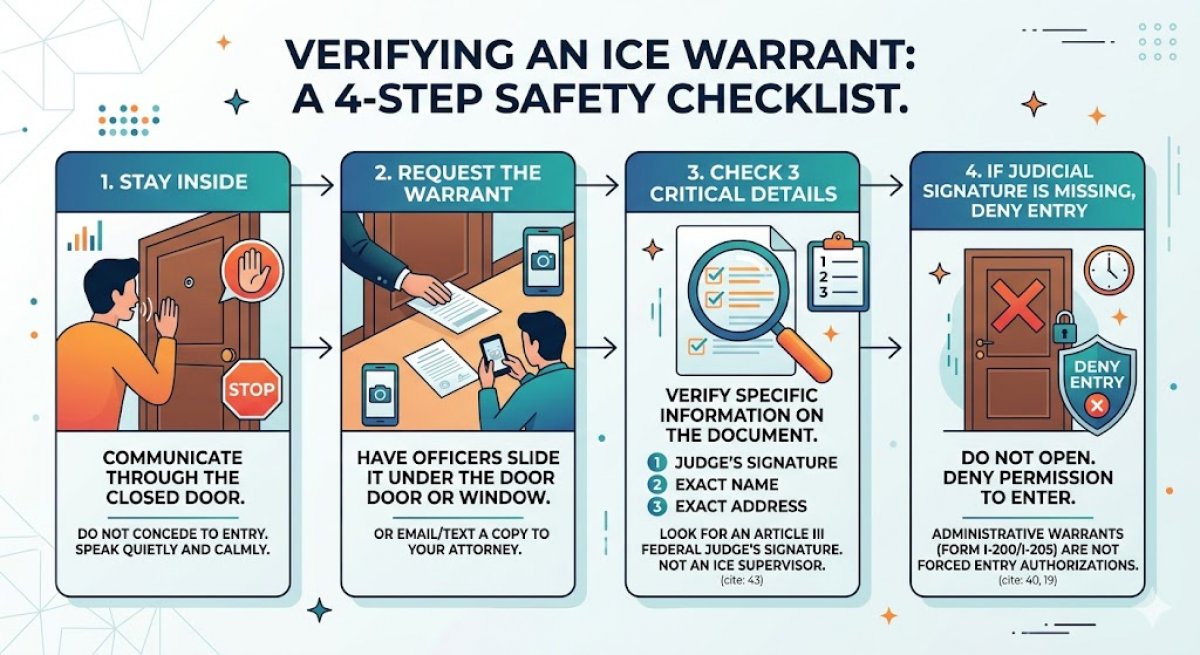
How do I verify an ICE warrant without opening the door?
Four steps. Keep it simple:
Stay inside. Speak through the door or a window.
Ask the officers to slide the warrant under the door, or hold it flat against a window so you can photograph it.
Check for three things: a judge's signature (not an ICE supervisor), your exact legal name, and your exact address. All three. Not two out of three.
If any piece is missing or wrong, that warrant does not unlock your door.
Want to speak with the officers anyway? You can, without letting them in. Step outside and pull the door shut behind you. That conversation, if you decide to have it, belongs on the porch.
What should I say if ICE officers start asking questions?
This part is harder than people expect, because silence feels rude and human beings are wired to fill it.
Fill it with one sentence: "I choose to remain silent."
Say it in English. Say it calmly. Say it again when they rephrase the question, because they will rephrase it. You owe no answer about where you were born, how you entered the country, or what status you currently hold. Those are the exact questions officers are trained to ask, because the answers are exactly what they need to build a case against you under the Immigration and Nationality Act.
A few things to keep in mind:
A printed Know Your Rights card in your wallet can do the talking for you. Slide it under the door, or hand it over if you have stepped outside.
You can decline to show foreign identity documents. A consular card, a foreign passport, anything that identifies your country of origin.
Never produce a false document. Ever. That is a federal offense stacked on top of whatever is already happening, and it will sink any future relief.
Never lie to a federal officer. Silence is not a lie. Use it.
Be aware that ICE agents sometimes identify themselves as "police" or claim to be investigating a crime in the neighborhood. Ask directly: "Are you from Immigration and Customs Enforcement?" If they are, the Fourth Amendment rules above apply.
Can ICE pressure me into signing something at the door?
They can try. Please do not.
This is where immigration lawyers' hearts break on a monthly basis: clients who signed a stipulated removal order or a voluntary departure form at three in the morning, thinking it was a standard intake document, not realizing they had just waived a hearing before an immigration judge or closed the door on years of future eligibility.
The rule is simple. You sign nothing until a lawyer has read it.
If an officer refuses to let you call counsel before signing, that refusal itself can become part of your defense later. The catch is that "later" only helps if somebody is there to build the defense. Yet another reason the attorney relationship should begin before the emergency, not during it.
What are my rights if a family member is already in ICE custody?
Different phase of the same fight. The clock is louder now.
A detained family member still has rights:
The right to an attorney. Not free, the way a criminal defense lawyer would be. But the right to have one is absolute. If they already have counsel, a signed Form G-28 (Notice of Entry of Appearance) is the document that notifies the facility.
The right to a phone call. After ten days in custody, a free call home is available if the detention account has run dry.
The right to a Detainee Handbook, which covers the specific facility's rules for visits, mail, legal calls, and grievances. Ask for it on day one.
The right to contact the consulate, which can sometimes assist in locating counsel and monitoring conditions of detention.
The right to a list of pro bono attorneys.
The right to a bond hearing in many (not all) cases, which a lawyer can request through a formal motion in immigration court.
On that pro bono point, let me be direct. A list is not the same thing as a dedicated legal team that returns your call the same afternoon, knows the officers at Elizabeth Detention Center or Farmville ICA, and can file a bond motion before your loved one is transferred to a facility in rural Louisiana. Free legal aid organizations do remarkable work. They are also drowning. Detention defense is a sprint, and you want somebody already running.
If a family member was detained in the last 24 hours, put the article down and call us.
How do I find someone detained by ICE?
Start with the Online Detainee Locator System (ODLS) at locator.ice.gov. You will need one of two things:
The detainee's A-Number (Alien Registration Number), plus country of birth, or
Full legal name, exact date of birth, and country of birth
A few practical notes the ICE website does not spell out:
ODLS only shows people currently in ICE custody or released within the last 60 days. If your relative was just picked up and the system shows nothing, try again in 8 to 24 hours.
Names on ODLS reflect whatever the person provided at intake. If your relative uses a different name day-to-day, search with their legal name as it appears on any prior USCIS filing.
Transfers between facilities are common in the first week. A relative located in New Jersey on Monday can be in Louisiana by Friday. An attorney can sometimes prevent or slow that transfer, but only if they are retained before the move.
We help clients locate detained family members as part of our standard detention defense intake. It should not take days to find your relative, and with a lawyer involved, it usually does not.
What if bond is denied or detention drags on? Habeas corpus in federal court.
Here is where most "know your rights" articles stop. They should not.
When a family member has been in ICE custody for weeks or months, and the immigration judge has either denied bond or refused to even hold a bond hearing, you still have a move left. It is the strongest one in the book.
A writ of habeas corpus under 28 U.S.C. § 2241 is a petition filed in U.S. District Court, the same level of federal court that handles criminal trials, civil rights cases, and injunctions against federal agencies. It forces the government to appear before an Article III federal judge (an independent judge confirmed by the Senate, not an immigration judge who works for the Department of Justice) and prove that continued detention is lawful.
Three reasons this matters in an ICE case:
It bypasses the immigration bureaucracy. Immigration judges work for the Department of Justice. Their decisions can be reversed or constrained by the Attorney General. Federal judges cannot. When an ICE detention has been deliberately structured to avoid judicial review (for example, when the immigration court declines jurisdiction to hold a bond hearing at all), habeas corpus is how you get the case in front of a judge with genuine independent authority.
There is a real legal clock. Under the Supreme Court's decision in Zadvydas v. Davis (2001), ICE cannot indefinitely detain someone whose removal is not reasonably foreseeable. After roughly six months of detention, the burden shifts to the government to prove removal will actually happen. In Demore v. Kim, the Court allowed mandatory detention only for a "brief period." Prolonged detention without a clear removal date is one of the strongest habeas grounds we see.
The remedy is substantive. If a federal judge grants the petition, the court can order release, order a bond hearing with proper burdens of proof, or rule that continued detention violates due process. No administrative body can water that order down.
When we file habeas petitions at Gozel Law Firm:
We confirm jurisdiction first, which means filing in the federal district where our client is physically held. Get this wrong and the case is dismissed on a technicality.
We move fast, because ICE can transfer a detainee to another district and moot the filing. The goal is to file before the van leaves the parking lot.
We do not always wait for a Board of Immigration Appeals ruling. Under the futility exception, we argue that seeking further administrative relief is pointless when the agency's policies are already set against our client, and take the case directly to federal court.
We target the right respondents (warden of the facility, ICE Field Office Director, DHS Secretary, and Attorney General) based on whether the petition is a "core" challenge to confinement or something else.
The statutory filing fee is five dollars. The stakes are your family's future. Not every ICE detention warrants a habeas petition, but every ICE detention warrants a serious immigration lawyer evaluating whether one is appropriate, and evaluating it quickly.
A composite case: how a closed door kept a family together
What follows is a composite drawn from matters our firm has handled. Names and details are changed.
Around 5:40 a.m. on a Tuesday, three officers knocked hard on a ground-floor apartment in Passaic County, New Jersey. The husband, a lawful permanent resident, answered through the door. Three officers in the hallway. A paper held up to the peephole. They wanted his wife.
Three things he did right, in order.
He kept the door closed. He asked them to slide the document under. He called us while the officers were still in the hallway.
Within four minutes, the attorney on call had a photo of the paper on her phone. Administrative warrant, not judicial. The unit number on the form did not match their apartment. No judge's signature anywhere on the document.
The officers left without an arrest. Over the following weeks, we filed the petition that put the wife's case on a different track, one that did not run through a detention facility in another state.
The entire outcome turned on three small decisions inside the first sixty seconds. Close the door. Ask for the paper. Make the call.
Why this article cannot replace an emergency immigration lawyer
This is general information. Not legal advice, and not a substitute for having an attorney evaluate your specific situation.
Why say so this bluntly? Because immigration law is fact-sensitive in a way few other areas of law are. Two families with nearly identical stories can walk out with opposite results, and the deciding variable is almost always something that was never going to fit in a flyer. A prior entry twelve years ago. A misdemeanor that looked minor on the intake form. A pending I-130 that has been sitting at the Texas Service Center since 2022 and nobody remembered was still alive. An asylum filing clock that quietly started on a date nobody wrote down.
A blog post cannot file an emergency stay of removal. It cannot argue a bond hearing. It cannot draft a writ of mandamus to force USCIS to act on a case the agency has been ignoring for years, which, as it happens, is one of our firm's core practice areas.
That is what Gozel Law Firm does.
The part nobody wants to read, but should
Most immigration cases are not lost in a courtroom. They are lost inside the first forty-eight hours, long before any judge touches the file.
Here is what that looks like in practice:
A voluntary departure form signed at dawn that permanently closes off future relief
A client moved from New Jersey to rural Louisiana overnight, which turns bond hearings and family visits into a logistical nightmare
A missed filing deadline for asylum, a motion to reopen, or a response to a Notice to Appear
A habeas corpus petition filed in the wrong federal district because the client was already transferred, resulting in dismissal on jurisdictional grounds
Inconsistent statements pulled out of different family members questioned separately at their kitchen tables
Every one of those is preventable. All of them require the same thing, which is a lawyer already in the picture, or called fast enough to get into it.
Three steps, today
Put our number in your phone under a name you can find in two seconds. Not "Lawyer," which is exactly where an officer would look.
Book a confidential consultation so we can review your status, any pending petitions, and your family's actual exposure before an emergency forces the conversation.
Send this article to anyone in your household, workplace, or community whose life it might one day touch.
There are no comments yet. Be the first to comment!