USCIS Can Refer Asylum Cases Without an Interview: July 27, 2026 Rule Explained
Index
- What Does the New Asylum Rule Change?
- Who May Be Referred Without an Interview?
- Does the Rule Apply to Pending Asylum Applications?
- How Many Cases Could Be Affected?
- Why the One-Year Filing Deadline Is Central to the Rule
- What Happens After USCIS Refers a Case?
- Why the Written Form I-589 Record Now Matters More
- How Different Applicants May Be Affected
- What Are the Broader Legal Consequences?
- How Does the Rule Change Asylum Mandamus Strategy?
- What Should Pending Asylum Applicants Do Now?
- Prepare the Record Before USCIS Decides the Next Step
- Sources
The affirmative asylum process has historically included an interview with a USCIS asylum officer before the agency grants, denies, or refers the application. A new Department of Homeland Security interim final rule changes that expectation. Once the rule takes effect, USCIS may refer certain affirmative asylum applications to immigration court without conducting an interview.
The change does not eliminate all asylum interviews, and a referral is not the same as a final denial of asylum. It does, however, make the written Form I-589 record significantly more important. Some applicants whose cases have been pending for years may be moved from the non-adversarial USCIS process into removal proceedings before an immigration judge without first receiving an opportunity to explain the claim face to face to an asylum officer.
The DHS interim final rule is scheduled for publication in the Federal Register on July 28, 2026, and states that it will become effective upon publication. This guide explains what the rule changes, which pending and future cases may be affected, what happens after referral, and why applicants should review their asylum records before USCIS acts.
What Does the New Asylum Rule Change?
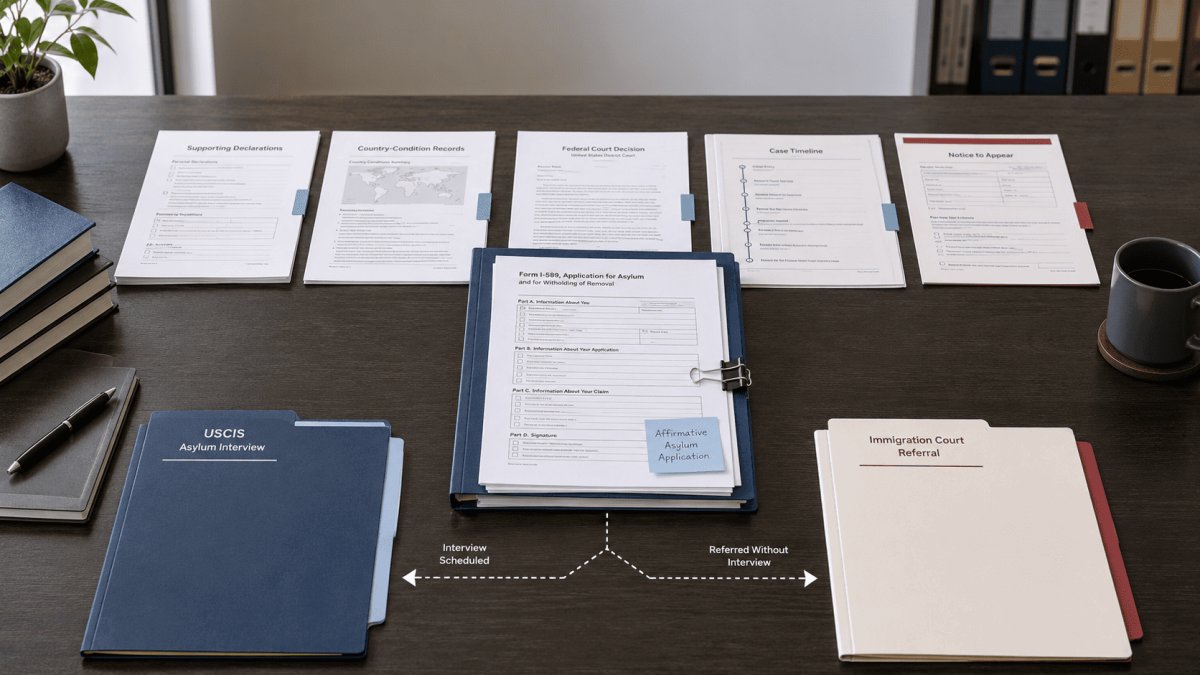
The rule allows a USCIS asylum officer to examine the Form I-589, supporting documents, background checks, agency records, and other relevant evidence and decide whether the application may be referred to the Executive Office for Immigration Review without an asylum interview.
This is a significant departure from USCIS’s longstanding general practice of interviewing affirmative asylum applicants before making a referral decision. DHS is also removing regulatory language that referred to a broader “right to an interview” in the affirmative asylum process.
| Issue | Previous General Practice | New Rule |
|---|---|---|
| Initial review | USCIS generally scheduled an asylum interview before deciding whether to grant, deny, or refer the application. | USCIS may identify certain cases for referral based on the written record and other relevant evidence. |
| Interview | An asylum officer generally interviewed the applicant and elicited testimony about eligibility, filing bars, and the underlying claim. | An interview may not be offered before referral in covered cases. |
| Request for Evidence | Applicants often expected to explain missing or unclear information during the interview. | USCIS may issue an RFE, but the rule states that some cases may be referred without an interview and without an RFE. |
| Referral letter | Existing regulations contemplated an assessment of credibility in the decision documentation. | A referral letter will not be required to include a credibility assessment when credibility is not the basis for referral. |
The new rule permits referral without an interview; it does not require USCIS to refer every potentially covered case. An asylum officer may still decide that an interview is necessary based on the application, supporting evidence, background checks, or other circumstances.
USCIS must continue to interview an applicant before granting asylum. The rule also states that USCIS will continue to offer an interview when the applicant maintains a lawful basis to remain in the United States and the agency may need to issue a denial rather than refer the application to immigration court.
Who May Be Referred Without an Interview?
The rule is primarily directed at affirmative asylum applicants who do not maintain a lawful basis to remain in the United States and whose cases can be referred to immigration court. It does not create automatic referral for every pending Form I-589. USCIS must still review the individual record and determine whether the case is appropriate for referral without an interview.
The rule identifies several categories that may be considered:
- A bar to applying for asylum: This may include the one-year filing deadline or another statutory prohibition on applying.
- A mandatory bar to a grant of asylum: Examples may involve certain serious crimes, persecution of others, terrorism-related grounds, or other statutory bars.
- An unfavorable exercise of discretion: Even when an applicant meets the basic statutory definition, asylum remains a discretionary form of relief.
- Ineligibility on the merits: USCIS may conclude from the written record that the facts do not establish eligibility for asylum.
These examples should not be treated as a closed list. The rule gives USCIS flexibility to issue future guidance identifying which case types may be prioritized based on agency operations, developing trends, national security, and public-safety priorities.
What Does “Lawful Basis to Remain” Mean?
The rule repeatedly uses the phrase “lawful basis to remain,” but applicants should not assume that every form of authorized stay produces the same result. A person maintaining valid nonimmigrant status presents a clearer example. The effect of parole, Temporary Protected Status, deferred action, a pending application, or another immigration circumstance may require case-specific legal analysis.
The question is also time-sensitive. A person may have held valid status when the Form I-589 was filed but no longer maintain that status when USCIS reviews the file. Applicants should therefore examine both their filing history and present immigration circumstances.
Does the Rule Apply to Pending Asylum Applications?
Yes. The rule is not limited to Form I-589 applications filed after its effective date. It also applies to qualifying affirmative asylum cases that were already pending with USCIS when the rule took effect.
DHS states that the new process may be used for pending cases that have not yet been scheduled for an initial asylum interview. USCIS may electronically identify files based on information such as the date of last entry, filing date, security-check results, and other case data. An asylum officer would then review the record to decide whether the applicant should receive an interview or whether the case may be referred without one.
| Case Situation | Possible Effect of the Rule |
|---|---|
| Form I-589 filed before the rule, with no interview scheduled | The case may be reviewed for possible referral without interview. |
| Initial interview already scheduled | The rule states that it affects applicants who have not yet been scheduled for an asylum interview. |
| Applicant maintains a lawful basis to remain | USCIS states that it will continue to offer an interview in cases where the applicant maintains a lawful basis to remain. |
| Record is unclear or incomplete | USCIS may schedule an interview or issue an RFE, but an RFE is not guaranteed. |
| Written record appears to establish a filing bar, grant bar, discretionary issue, or merits problem | USCIS may consider referral without an interview if the applicant is amenable to referral to EOIR. |
This retroactive operational effect is particularly important for people who filed years ago. Some applicants may have prepared a shorter declaration or planned to explain complicated facts during the interview because the prior system generally provided that opportunity. DHS acknowledges that applicants may have become accustomed to presenting sensitive parts of their claims in a face-to-face, non-adversarial setting.
How Many Cases Could Be Affected?
DHS estimates that the affirmative asylum backlog reached 1,434,145 pending cases at the end of fiscal year 2025. The rule identifies a substantial portion of that backlog as potentially affected, particularly cases involving the one-year filing deadline.
| Figure | What It Represents | Important Limitation |
|---|---|---|
| 1,434,145 | Affirmative Form I-589 cases pending at the end of FY 2025 | This is the total backlog, not the number that will be referred. |
| 444,724 | Pending cases identified as filed more than one year after last entry or with a blank entry date, subject to the rule’s data filters | These cases are potentially affected; they are not automatic referrals. |
| 31% | The approximate share of the FY 2025 backlog represented by the 444,724 cases | The figure focuses on potential one-year filing deadline issues. |
| 132,167 annually | DHS estimate of future affirmative applicants who may potentially be referred because of a filing bar, grant bar, or unfavorable discretionary determination | DHS does not have a separate estimate for cases that may be referred based on the merits. |
The 444,724 figure should not be described as the number of people USCIS has decided to refer. It includes applications with a possible one-year filing issue based on agency data, including some files with a missing or potentially incorrect entry date. Each case still requires review of the application, exceptions, supporting documents, and other available evidence.
DHS also reviewed cases from fiscal years 2021 through 2025 involving untimely filings that were ultimately referred after interview. The agency reports that approximately 76.9% of those referrals were based on the one-year filing deadline. DHS relies on this data to argue that an interview frequently did not change the filing-deadline outcome in that defined group. The percentage does not mean that 76.9% of every late-filed asylum application will be referred or denied.
Why the One-Year Filing Deadline Is Central to the Rule
In most cases, a person must file Form I-589 within one year of the date of the person’s last arrival in the United States. The USCIS affirmative asylum guidance recognizes exceptions for qualifying changed circumstances or extraordinary circumstances.
Under the new rule, an applicant should not assume that a late-filing explanation can wait until the asylum interview. USCIS may examine the entry date, filing date, declaration, supporting documents, immigration records, and background information and decide the filing-deadline issue from the written record.
Changed Circumstances
Changed circumstances may include developments that materially affect asylum eligibility. Depending on the facts, this could involve significant changes in the applicant’s country of nationality, changes in U.S. law, new political or religious activity, or another event that materially affects the claim.
Extraordinary Circumstances
Extraordinary circumstances may excuse a delayed filing when the circumstances were directly related to the failure to file within one year. Examples can include serious illness, mental or physical disability, certain effects of legal representation problems, maintaining lawful status, or other recognized circumstances.
Filing Within a Reasonable Period
Identifying an exception is not always enough. The applicant generally must also show that Form I-589 was filed within a reasonable period after the changed or extraordinary circumstances. The declaration and exhibits should explain the complete timeline rather than merely name an exception.
Missing or Incorrect Entry Dates
The rule specifically discusses cases with blank entry dates or data that initially indicate a one-year filing issue. A missing or incorrect date can create a serious problem even when the applicant actually filed on time. Applicants should compare Form I-589 against passport records, Form I-94 information, visa records, prior filings, travel history, and any statements previously provided to DHS.
A late-filed asylum case should explain three points clearly: what circumstance created the exception, how that circumstance caused or affected the delay, and why the application was filed within a reasonable period afterward.
Has your asylum application been pending without an interview?
Before asking USCIS or a federal court to move the case, review the Form I-589, filing deadline, immigration history, declarations, supporting evidence, and possible consequences of agency action.
What Happens After USCIS Refers a Case?
A referral does not mean that USCIS has issued a final order of removal or permanently rejected the asylum claim. It generally means USCIS has not granted asylum and is transferring the claim to an immigration judge for consideration in removal proceedings.
The applicant may receive a Notice to Appear, which contains the government’s allegations and immigration charges. Proceedings begin after the charging document is properly filed with the immigration court. Hearing notices and filing deadlines should be treated seriously and addressed promptly.
The Immigration Judge Reviews the Claim Again
The rule states that an applicant referred without an interview retains the opportunity to present the asylum claim to an immigration judge de novo. This means the judge conducts an independent evaluation rather than simply reviewing whether the USCIS asylum officer made the correct decision.
The applicant may submit testimony, declarations, documentary evidence, country-condition materials, legal arguments, and evidence supporting an exception to the one-year filing deadline. The applicant may also continue to seek withholding of removal and, where applicable, protection under the Convention Against Torture.
Referral Changes the Procedural Environment
Although the claim can still be presented, the setting changes substantially. A USCIS affirmative interview is designed as a non-adversarial agency interview. Removal proceedings are formal court proceedings in which DHS is represented by government counsel, the applicant must answer the immigration charges, and the judge manages evidentiary and filing deadlines.
| USCIS Affirmative Process | Immigration Court Process |
|---|---|
| Non-adversarial asylum interview | Adversarial removal proceedings |
| USCIS asylum officer reviews the application | Immigration judge decides the protection claims and other matters within the court’s jurisdiction |
| No DHS trial attorney questioning the applicant during the ordinary affirmative interview | DHS counsel may examine the record, challenge eligibility, and question witnesses |
| Agency interview and decision process | Master calendar hearings, filing deadlines, possible individual merits hearing, and appeal rights |
| Possible grant, denial for applicants who may lawfully remain, or referral | Possible grant of relief, denial, or entry of a removal order, subject to applicable review and appeal |
USCIS explains that referral means the immigration judge will decide the asylum application during removal proceedings. Applicants facing this transition should not ignore mail from USCIS, DHS, or EOIR. They should also check the immigration court system after receiving charging documents and preserve proof of all address updates.
Does Referral Automatically End the Work Permit?
The rule does not state that referral alone automatically terminates an asylum-based Employment Authorization Document. Employment authorization generally depends on whether the underlying asylum application remains pending and whether the applicant satisfies the separate EAD rules.
Referral can nevertheless affect which agency has the asylum record, the asylum EAD clock, future filings, and the consequences of applicant-caused delays. Applicants should review their individual EAD history rather than assume that referral has no employment consequences or that an existing card will remain renewable in every situation.
Why the Written Form I-589 Record Now Matters More
The rule contemplates revised Form I-589 instructions warning that USCIS may refer an application without an interview and without requesting further evidence. The instructions are expected to emphasize that the application and documents submitted with it may be the applicant’s only opportunity to meet the burden before USCIS.
This does not mean that every pending applicant should immediately submit a large, unorganized supplement. Additional filings should be accurate, relevant, consistent with the existing record, and accompanied by a clear explanation when they correct or expand earlier statements.
Review the Form I-589 Itself
Applicants should verify names, addresses, family information, immigration history, dates of entry, prior applications, arrests, organizational affiliations, and every yes-or-no eligibility question. A blank answer, mistaken date, or incomplete explanation may affect both the underlying asylum claim and the referral analysis.
Review the Personal Declaration
The declaration should explain the protected ground, past harm, future fear, identity of the persecutor, the government’s role or inability to provide protection, internal relocation issues, and other elements relevant to the particular claim. General statements should be replaced with specific facts, dates, locations, and context where accurate and available.
Check Consistency Across Every Immigration Record
USCIS may compare Form I-589 with visa applications, border statements, credible-fear records, prior immigration forms, criminal records, social-media information, background checks, and other government databases. Material inconsistencies should be addressed carefully rather than ignored.
A correction should explain what was inaccurate, why the error occurred, and what evidence supports the corrected information. Rushed amendments can create new credibility problems when they conflict with the original filing without a coherent explanation.
Submit Important Evidence Strategically
Relevant evidence may include identity documents, proof of entry, medical records, police reports, court documents, affidavits, expert materials, country-condition evidence, evidence of political or religious activity, and records supporting an exception to the one-year filing deadline.
USCIS may issue an RFE when further information is needed, but the agency expressly states that some pending applications may be referred without an interview and without an RFE. Applicants should therefore not rely on USCIS to identify every missing document before taking action.
How Different Applicants May Be Affected
The rule does not create the same level of risk for every asylum applicant. The following distinctions can help frame an initial review, but they do not replace individualized legal analysis.
| Applicant Profile | Potential Effect | Important Review Point |
|---|---|---|
| Filed within one year and has a detailed, well-supported claim | The case is not automatically protected from referral, but it may not present the filing-deadline issue emphasized by the rule. | Merits, grant bars, discretion, and present lawful basis to remain |
| Filed more than one year after last arrival | The case may receive closer review for possible referral without interview. | Changed or extraordinary circumstances and reasonable-period evidence |
| Maintains a lawful basis to remain | USCIS states that it will continue to offer an interview in these cases. | Whether the lawful basis remains valid at the time of review |
| No current lawful basis to remain and no interview scheduled | The applicant falls within the general population the rule is designed to address. | Complete review of filing bars, grant bars, discretion, and merits |
| Interview already scheduled | The rule states that it applies to applicants who have not yet been scheduled for an initial asylum interview. | Continue interview preparation and monitor for any agency notice |
| Unaccompanied child | Unaccompanied children are exempt from the one-year filing deadline, but other eligibility issues may still require review. | Jurisdiction, UAC determination, merits, and any separate bars |
| Criminal, security, or organizational-history issue | Background checks and Form I-589 responses may identify a possible mandatory bar or discretionary concern. | Certified dispositions, police reports, charging records, and legal analysis of the specific conduct |
| Derivative spouse or child | The family may be affected by action on the principal application, but individual immigration circumstances and bars can differ. | Derivative eligibility, age, marital status, lawful status, and independent protection options |
What Are the Broader Legal Consequences?
DHS presents the rule as a way to reduce the USCIS affirmative asylum backlog and direct interview resources toward cases in which testimony may affect the agency’s decision. The rule may help USCIS move files out of its pending inventory, but it may also transfer substantial work to an immigration court system that already has a very large caseload.
According to the EOIR adjudication statistics for the second quarter of fiscal year 2026, immigration courts had approximately 3.57 million pending cases. Moving a case from USCIS to EOIR may therefore produce an earlier referral without necessarily producing a faster final decision.
Loss of the Non-Adversarial Interview Stage
For some applicants, the asylum interview is the first structured opportunity to explain trauma, clarify translation problems, correct misunderstandings, and provide context for a declaration prepared years earlier. Referral without that stage may place more pressure on the initial written filing and on later litigation before the immigration judge.
Possible Administrative Procedure Act Challenges
DHS issued the change as an interim final rule without prior notice-and-comment and without a delayed effective date. The agency argues that the rule concerns agency procedure or practice and that it does not change the substantive standards for asylum. DHS also invokes the foreign-affairs exception and other grounds supporting immediate implementation.
Potential challengers may argue that removing the expected interview opportunity has substantial practical effects on how applicants establish filing-deadline exceptions, credibility, and eligibility. They may also raise concerns about the application of the rule to people who filed under the longstanding expectation that they would be interviewed.
Reliance Interests and Due Process Concerns
DHS expressly acknowledges that pending applicants may have relied on the former interview practice and that some people may be more comfortable discussing sensitive facts face to face. The agency responds that applicants may supplement their records, USCIS may issue an RFE, and the immigration judge can consider the claim de novo.
Whether those safeguards are sufficient may become the subject of federal litigation. The existence of possible arguments does not mean a court will automatically block the rule. Any challenge will depend on the claims asserted, jurisdiction, standing, administrative record, and the way USCIS implements the new authority.
How Does the Rule Change Asylum Mandamus Strategy?
Applicants who have waited years for an asylum interview sometimes consider a federal mandamus lawsuit for an asylum interview delay. A mandamus action generally asks a federal court to require the agency to perform a duty that has been unreasonably delayed. It does not authorize the court to dictate that USCIS approve the asylum application.
The new rule adds another important limitation: agency action may not always take the form the applicant expects. If USCIS has legal authority to refer a covered case without an interview, action prompted by litigation could potentially result in an interview, an RFE, continued agency review, or referral to immigration court, depending on the record and the agency’s implementation of the rule.
Mandamus Does Not Guarantee an Interview
A complaint should not promise that federal litigation will necessarily produce an asylum interview. The requested relief, agency duty, regulatory framework, plaintiff’s immigration circumstances, and available causes of action must all be examined carefully.
Gozel Law’s guide to filing a mandamus lawsuit explains the general federal process. After this rule, asylum-delay cases require an additional pre-filing question: Is the existing Form I-589 record ready for USCIS to act on immediately?
Review the Merits Before Trying to Accelerate the Timeline
A pre-suit review should address the filing date, date of last arrival, lawful status history, changed or extraordinary circumstances, criminal history, organizational affiliations, potential bars, declaration, supporting evidence, derivative family members, and possible consequences of referral.
This does not mean mandamus is no longer available in asylum-delay cases. Long agency inaction may still support litigation under mandamus, the Administrative Procedure Act, or both. The strategy, requested relief, and risk assessment should be tailored to the individual record rather than based only on the number of years the case has been pending.
For a pending asylum case, “getting USCIS to act” and “getting USCIS to schedule an interview” may no longer mean the same thing. The possible outcome of agency action should be evaluated before federal litigation is filed.
What Should Pending Asylum Applicants Do Now?
Applicants should not panic or assume that every pending case will be referred. The rule creates discretionary authority, and USCIS must still review the record. It does, however, make a careful file audit more urgent for people who have not yet been scheduled for an interview.
- Obtain a complete copy of the filing: Review the exact Form I-589, declaration, translations, exhibits, cover letter, and filing receipt.
- Confirm the last-entry and filing dates: Compare the application with passport stamps, Form I-94 records, visa records, and prior government filings.
- Document any filing-deadline exception: Explain the changed or extraordinary circumstance, its connection to the delay, and the timing of the eventual filing.
- Review every eligibility and security question: Confirm that arrests, charges, convictions, organizations, military activity, and other sensitive matters were disclosed accurately.
- Check the declaration for completeness and consistency: Identify material omissions, unclear timelines, translation problems, and conflicts with other immigration records.
- Organize important supporting evidence: Prioritize relevant documents that prove the claim, filing-deadline exception, identity, entry history, and current circumstances.
- Update addresses correctly: Keep USCIS informed while the case remains with USCIS and follow separate EOIR address-change requirements if the case is placed in court.
- Preserve all communications: Save notices, envelopes, tracking records, online-account screenshots, uploads, service requests, and proof of delivery.
- Review the case before seeking acceleration: Evaluate the possible consequences of USCIS action before filing an expedite request or federal lawsuit.
Applicants should avoid sending unexplained corrections or inconsistent evidence simply because the rule has changed. A supplement should be accurate, organized, legally relevant, and prepared with an understanding of how USCIS and an immigration judge may compare it with the original record.
Prepare the Record Before USCIS Decides the Next Step
The new rule does not end affirmative asylum or prevent an applicant from presenting a protection claim to an immigration judge. It does change a major procedural expectation. Some applicants may no longer receive a USCIS interview before the agency moves their cases into immigration court.
For people with pending applications, the most important step is to understand what USCIS will see when it reviews the file. A complete and consistent Form I-589, a well-supported filing-deadline explanation, accurate immigration and criminal history, and carefully organized evidence may now matter before an interview is ever scheduled.
Applicants considering an expedite request or federal delay lawsuit should also reassess what agency action could mean under the new rule. The goal should not be speed alone. The strategy should account for the strength of the written record, the risk of referral, and the applicant’s readiness to proceed before an immigration judge.
Is your affirmative asylum application still pending with USCIS?
Contact our team for an evaluation of your Form I-589, one-year filing deadline, supporting evidence, lawful-status history, possible referral issues, and the risks and benefits of seeking agency action.
Phone: +1 (862) 799-2200 | Email: info@gozellaw.com
Legal Disclaimer
This article is provided for general informational purposes only and does not constitute legal advice. Every immigration case has unique circumstances. For legal guidance specific to your situation, we recommend consulting with an experienced immigration attorney. The information in this article reflects laws and policies as of the publication date; subsequent changes, litigation, implementation guidance, or court orders may affect its accuracy.
Sources
- Department of Homeland Security: Affirmative Asylum Referrals Without Interview, Interim Final Rule
- Federal Register: Public Inspection Page for Affirmative Asylum Referrals Without Interview
- DHS: USCIS Announces Rule Change to Asylum System to Reduce Backlog
- USCIS: The Affirmative Asylum Process
- USCIS: Affirmative Asylum Frequently Asked Questions
- USCIS: Form I-589, Application for Asylum and for Withholding of Removal
- Executive Office for Immigration Review: Adjudication Statistics, FY 2026 Second Quarter
- EOIR: Asylum, Withholding of Removal, and Convention Against Torture
- 8 U.S.C. § 1158: Asylum
- 8 C.F.R. § 208.7: Employment Authorization
- 5 U.S.C. § 553: Administrative Procedure Act Rulemaking Requirements
Frequently Asked Questions About July 27, 2026 Rule
No. USCIS must still conduct an interview before granting asylum. The rule also states that USCIS will continue to offer interviews in cases where the applicant maintains a lawful basis to remain and in cases where the officer cannot determine the appropriate action from the written record.
Yes. USCIS may issue a Request for Evidence when more information is needed, but the rule states that some pending applications may be referred without an interview and without an RFE.
No. Referral generally means the asylum claim moves to immigration court. The immigration judge can independently consider the application during removal proceedings.
Yes. The rule states that an applicant referred without an interview may present the claim to the immigration judge de novo. The applicant may submit testimony, evidence, and arguments, including evidence supporting an exception to the one-year filing deadline.
Yes. It applies to qualifying pending affirmative applications as well as future filings. The rule specifically discusses pending cases that have not yet been scheduled for an initial asylum interview.
You may still have an exception based on changed or extraordinary circumstances. The exception and the timing of the filing should be documented in detail. A late filing does not automatically mean that no protection is available, and withholding of removal may remain available even when the one-year asylum deadline cannot be excused.
The rule does not provide for automatic termination of an EAD solely because USCIS refers the asylum application. Work authorization depends on separate regulations, whether the application remains pending, the asylum EAD clock, renewal requirements, and the applicant’s individual history.
Potentially. The viability of federal litigation depends on the length and circumstances of the delay, the legal duty asserted, available remedies, jurisdiction, and the applicant’s record. The lawsuit cannot guarantee approval or guarantee that USCIS will schedule an interview instead of taking another legally available action.
There are no comments yet. Be the first to comment!