I Filed My Mandamus Lawsuit. Now What? The Anatomy of the Next 60 Days
Index
- Why the First 60 Days Matter in a Mandamus Lawsuit
- Filing Is Only the First Step
- What the Government Does After Service
- The Anatomy of the Next 60 Days
- Does Mandamus Guarantee Approval?
- What If the Government Files a Motion to Dismiss?
- What You Should and Should Not Do While Waiting
- Conclusion
- Need Help With a Delayed Immigration Case?
- Legal Disclaimer
- Sources
Filing a mandamus lawsuit can feel like a line has finally been drawn. After months or years of waiting for USCIS, the Department of State, or another immigration agency to act, your delayed case is now in federal court. That is a serious step, and it usually brings a new question right away: what happens after filing mandamus?
The first 60 days matter because they shape the early direction of the lawsuit. This period usually involves service of process, government review, possible agency movement, and sometimes a formal response from the U.S. Attorney's Office. Knowing what each stage means can help you stay calm, organized, and ready to respond if your immigration case suddenly starts moving.
Why the First 60 Days Matter in a Mandamus Lawsuit
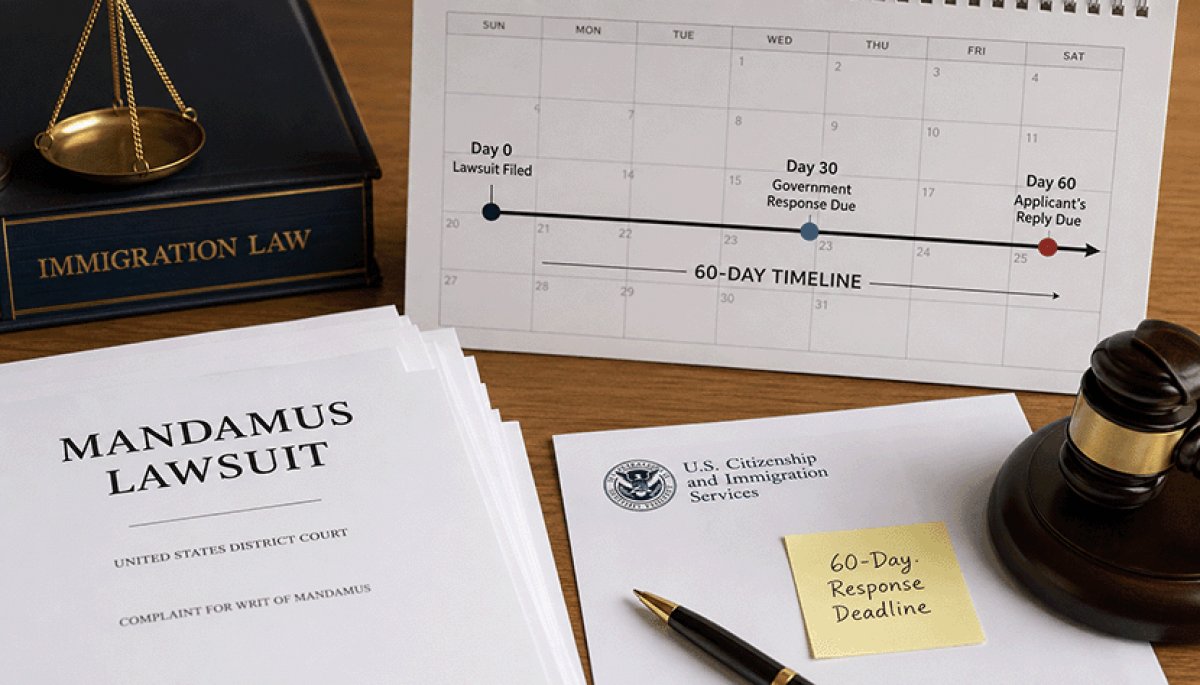
The 60-day reference point comes from federal procedure. Under Federal Rule of Civil Procedure 12(a)(2), the United States, a U.S. agency, or a federal officer sued in an official capacity generally has 60 days to serve an answer after service on the U.S. Attorney.
That does not mean your case will end in exactly 60 days. Some cases move before the government files an answer because the agency reviews the immigration file and decides to act. Other cases take longer if the government requests more time, files a motion, or contests the lawsuit. Still, the 60-day window is usually the first major checkpoint after proper service.
For immigration applicants, this period can be meaningful. A case that has been sitting for years may finally receive focused attention from agency counsel, government attorneys, or both. If you filed a mandamus lawsuit for immigration delays, the early court timeline may push the agency to identify the reason for the delay and decide whether action can be taken.
Filing Is Only the First Step
A common misunderstanding is that the 60-day clock starts the moment the complaint is filed. Filing opens the case with the federal court, but the government's response deadline is usually tied to proper service. The defendants must be formally notified in the way the federal rules require.
When a mandamus lawsuit names a federal agency or federal officer, service is more detailed than sending a copy to USCIS. Federal Rule of Civil Procedure 4(i) requires service on the United States and also requires mailing a copy of the summons and complaint to the agency, officer, or employee involved in the official-capacity case.
In practice, this usually means several separate steps. Your legal team may need to handle the complaint, summonses, service on the U.S. Attorney's Office, mailing to the Attorney General, and mailing to the agency officials named in the lawsuit. A mistake here can slow the case down, so service should be tracked carefully.
- Filing opens the federal lawsuit.
- Service notifies the proper government offices and officials.
- The response deadline usually runs from proper service, not from the filing date alone.
If you are still deciding whether to sue, our guide on how to file a mandamus lawsuit explains the earlier steps in more detail.
What the Government Does After Service
Once service is complete, the case usually reaches the U.S. Attorney's Office. A government attorney may appear in the federal case, review the complaint, and contact the agency involved in the delayed immigration matter. From the applicant's perspective, this stage can look quiet. Behind the scenes, the government may be checking the file, the delay history, the type of application, and whether the agency can move the case without further litigation.
The agency's response can take different forms. In some cases, there is no visible movement right away. In others, the applicant receives an interview notice, a request for evidence, an updated case status, or even a decision. A mandamus lawsuit is designed to challenge unreasonable delay, so any meaningful agency action during this period may affect the direction of the federal case.
| Possible development | What it may mean | What you should do |
|---|---|---|
| Attorney appearance | The government attorney has entered the case. | Let your attorney monitor the docket and response deadline. |
| Interview notice or RFE | The agency may be taking action on the underlying immigration case. | Send the notice to your attorney immediately. |
| Extension request | The government wants more time to respond. | Review the request with counsel before taking a position. |
| Final decision | The agency may have resolved the delayed matter. | Ask your attorney how the decision affects the federal lawsuit. |
For many applicants, the most valuable part of a mandamus case is that the file is no longer sitting in silence. Gozel Law has handled mandamus matters where agency movement came in a relatively short period after the lawsuit was properly prepared, filed, and served. Results still depend on the facts of each case, but early pressure and careful case strategy can make a real difference.
The Anatomy of the Next 60 Days
Every case has its own pace. The outline below is a practical roadmap, not a promise. It shows what often happens after service in an immigration mandamus case.
Days 1 to 15: Service, Docket Setup, and Initial Review
During the first couple of weeks, the focus is usually on completing and confirming service. The court docket may show summonses issued, returns of service, attorney appearances, or other administrative entries. If service is incomplete, the government's response deadline may not be running yet.
This is also when your attorney may check that the correct defendants were served. In an immigration delay case, the defendants may include officials connected to USCIS, the Department of State, DHS, or another federal component, depending on the application type.
Days 15 to 45: Agency Review and Possible Movement
The middle part of the 60-day period is often where meaningful activity happens. Government counsel may ask the agency why the case remains pending. If the agency can act, you may see movement before the government files a formal answer.
Movement does not always mean approval. It may mean an interview notice, a request for evidence, a notice of intent to deny, completion of a security check, transfer of the file, or a final decision. The legal purpose of mandamus is to seek action that has been unlawfully withheld or unreasonably delayed. The Administrative Procedure Act allows courts to compel agency action unlawfully withheld or unreasonably delayed under 5 U.S.C. § 706(1).
Days 45 to 60: Answer, Extension, Motion, or Resolution
As the deadline approaches, a few things may happen. The government may answer the complaint. It may ask for more time. It may file a motion to dismiss. Or the agency may take action that resolves the delay issue, which can lead the parties to dismiss the federal lawsuit by agreement.
If the agency issues a decision, your attorney should review whether the lawsuit has achieved its purpose and whether anything remains to be addressed. If the government contests the case, your attorney will evaluate the response and prepare the next filing strategy.
Does Mandamus Guarantee Approval?
No. A writ of mandamus is not a request for the court to approve your green card, citizenship application, visa, asylum application, or other immigration benefit. It is a lawsuit asking the court to require the government to act on a case that has been unreasonably delayed.
This distinction matters. A strong mandamus strategy may lead the agency to issue a decision, but that decision can be an approval, denial, request for evidence, interview notice, or another legally meaningful action. The American Immigration Council's practice advisory on mandamus and APA delay cases explains that these lawsuits are used to challenge agency inaction and delay. They are not a guarantee of a specific immigration result.
This is why careful screening matters before filing. A mandamus case should be based on more than frustration. The attorney should review the filing date, application type, processing history, prior inquiries, agency explanations, and any facts that may make the delay more or less reasonable. For a broader overview of timing, costs, and risks, see our mandamus lawsuit timeline and risks guide.
What If the Government Files a Motion to Dismiss?
A motion to dismiss can feel discouraging, but it does not automatically end the case. It is a procedural filing asking the court to dismiss the lawsuit before the case moves further. In immigration delay cases, the government may argue that the delay is not unreasonable, that the court lacks authority to order the requested action, or that the agency has already acted enough to make the case moot.
Courts often evaluate unreasonable-delay claims using the TRAC framework, which comes from Telecommunications Research & Action Center v. FCC. The TRAC factors look at the length and reasonableness of the delay, the interests affected by the delay, and the impact that court-ordered action may have on agency priorities.
For applicants, the main point is simple: a mandamus lawsuit is not just about counting months. The full context matters. A two-year delay may look different depending on the application type, the agency involved, the reason given for the delay, and the harm caused by continued waiting.
- Family separation may strengthen the practical urgency of the case.
- Work authorization problems may show concrete harm.
- Aging-out concerns may require faster attention.
- Long periods with no meaningful agency update may support an unreasonable-delay argument.
If the government files a motion, your attorney's response should connect your facts to the legal framework and explain why the delay is unreasonable in your specific circumstances. This is one reason many applicants work with a mandamus lawyer for delayed USCIS cases instead of trying to handle federal litigation alone.
What You Should and Should Not Do While Waiting
The waiting period after filing can be stressful. You may see nothing on the public docket for days or weeks. You may also receive an agency notice suddenly after a long period of silence. The best approach is to stay organized and avoid acting without legal guidance.
Do these things
- Send every USCIS, DOS, or court notice to your attorney right away.
- Save online case status screenshots if the status changes.
- Keep copies of receipts, service requests, congressional inquiries, ombudsman requests, and agency emails.
- Tell your attorney about address changes, travel plans, new arrests, new filings, or major family changes.
- Continue checking official tools, including USCIS Case Status Online and the USCIS processing times tool.
Avoid these mistakes
- Do not assume that no docket update means nothing is happening.
- Do not file duplicate applications or requests without legal advice.
- Do not ignore a request for evidence, interview notice, or agency message.
- Do not contact multiple government offices with inconsistent explanations of your case.
Once a federal case is pending, communication strategy matters. A new service request, congressional inquiry, or direct message to the agency may help in some situations. In others, it may create confusion. Your attorney can help decide which step fits the litigation posture.
Conclusion
The period after filing a mandamus lawsuit can feel uncertain, but it has structure. Filing opens the case. Proper service triggers key response deadlines. The first 60 days often show whether the agency will act, the government will respond, or the litigation will continue. During that time, your role is to stay organized, send every update to your attorney, and avoid steps that could interfere with the strategy.
Need Help With a Delayed Immigration Case?
For a personalized evaluation of your U.S. immigration case, contact our team. We will review your timeline, identify the delay history, and discuss whether a mandamus lawsuit may fit your situation.
Contact Us or call +1 (862) 799-2200.
Legal Disclaimer
This article is provided for general informational purposes only and does not constitute legal advice. Every immigration case has unique circumstances. For legal guidance specific to your situation, we recommend consulting with an experienced immigration attorney. The information in this article reflects laws and policies as of the publication date; subsequent changes may affect its accuracy.
Sources
- Federal Rule of Civil Procedure 12, Legal Information Institute, accessed May 12, 2026.
- Federal Rule of Civil Procedure 4, Legal Information Institute, accessed May 12, 2026.
- 5 U.S.C. § 706, Legal Information Institute, accessed May 12, 2026.
- Mandamus and APA Delay Cases: Avoiding Dismissal and Proving the Case, American Immigration Council, February 22, 2021.
- Telecommunications Research & Action Center v. FCC, Justia, accessed May 12, 2026.
- USCIS Case Status Online, USCIS, accessed May 12, 2026.
- Check Case Processing Times, USCIS, accessed May 12, 2026.
Frequently Asked Questions
In most federal cases against the United States or a federal agency, the 60-day response period is tied to service on the U.S. Attorney. It does not usually run from the filing date alone.
Yes. In some cases, agency action happens before the government files a formal answer or motion. The agency may also issue an RFE, schedule an interview, transfer the file, or take another step.
Yes. The government may request an extension, and courts often consider reasonable extension requests. Whether an extension makes sense depends on the facts and the reason given.
Mandamus generally seeks a decision, not a guaranteed approval. If the agency denies the case, your attorney can evaluate whether an appeal, motion, refiling, or another legal option may be available.
Many mandamus cases are handled through written filings, and many resolve before any hearing. Court appearance requirements depend on the judge, the government's response, and the direction of the case.
Some cases resolve within the early response window. Others continue longer if the government contests the lawsuit. The first 60 days are important, but they are not always the entire case.
There are no comments yet. Be the first to comment!