U.S. Citizenship by Marriage 2026: 3-Year Rule Timeline
Index
- What U.S. Citizenship by Marriage Means
- The 3-Year Rule for Spouses of U.S. Citizens
- Citizenship by Marriage Timeline: When Can You File Form N-400?
- What to Prepare Before Filing an N-400 Marriage-Based Case
- Common Mistakes That Can Complicate the Case
- What Happens After Filing Form N-400?
- Conclusion
- Sources
If you received your green card through marriage to a U.S. citizen, you may be able to apply for naturalization earlier than many other permanent residents. The regular rule is five years. For certain spouses of U.S. citizens, the waiting period may be reduced to three years.
That is what people usually mean when they search for u.s. citizenship by marriage. It does not mean marriage gives automatic citizenship. It means a qualifying lawful permanent resident may file Form N-400 under the 3-year rule if the legal requirements are met.
This guide explains the 2026 citizenship by marriage timeline, how the 3-year rule works, when you may file Form N-400, what to prepare before filing, and which issues can delay or complicate a marriage-based naturalization case.
What U.S. Citizenship by Marriage Means
“Citizenship by marriage” is a common phrase, but it can create confusion. A person does not become a U.S. citizen simply by marrying a U.S. citizen. Marriage may help with immigration benefits, but naturalization is still a separate legal process.
In most cases, the path looks like this:
- You marry a U.S. citizen.
- You become a lawful permanent resident, often through a marriage green card case.
- You meet the naturalization requirements for spouses of U.S. citizens.
- You file Form N-400.
- You attend the naturalization interview and, if approved, the oath ceremony.
This is different from getting a green card through marriage. A marriage green card gives you permanent resident status. Naturalization is the later step where you ask USCIS to approve you for U.S. citizenship.
If you are still at the green card stage, you may want to review Gozel Law’s information on family-based immigration before focusing on the N-400 timeline. If you already have your green card, the main question becomes whether you qualify for citizenship and naturalization under the 3-year rule.
The 3-Year Rule for Spouses of U.S. Citizens
The 3-year rule is a shortened naturalization path for certain spouses of U.S. citizens. The legal requirements are more specific than many applicants expect. It is not enough to be married. You must also show that the marriage, residence, and timing requirements line up correctly.
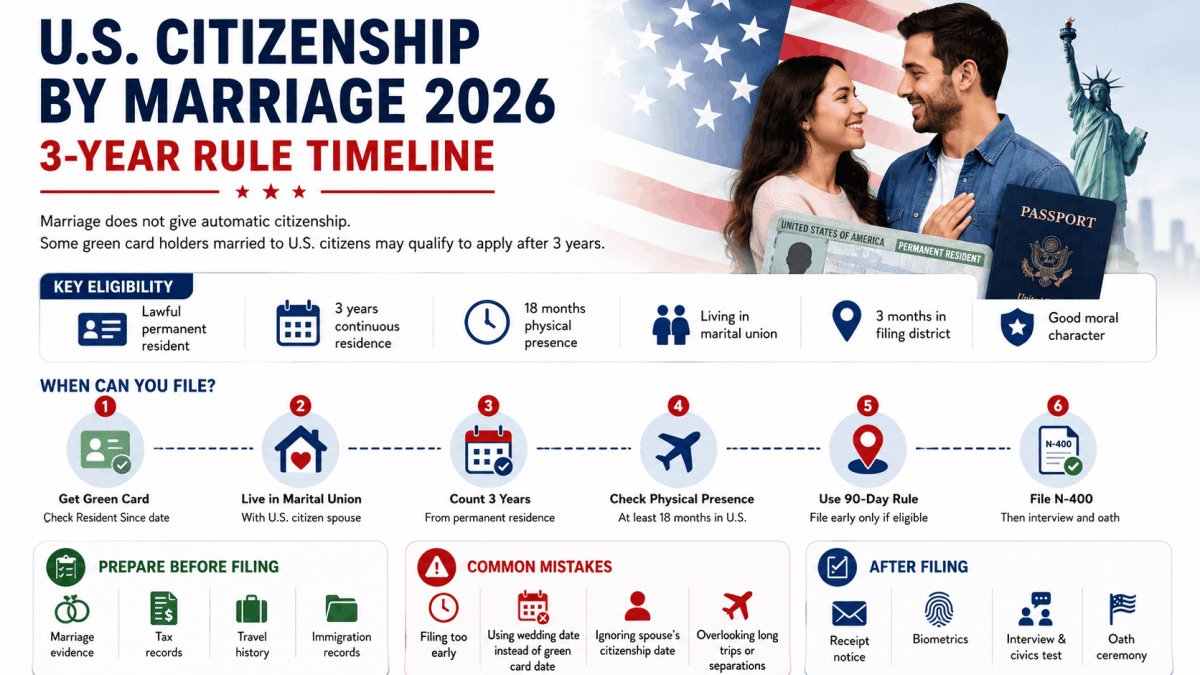
Under 8 CFR § 319.1, a spouse of a U.S. citizen generally must show that they:
- are a lawful permanent resident;
- have lived continuously in the United States for at least three years after becoming a permanent resident;
- have lived in marital union with the U.S. citizen spouse during the required period;
- have been physically present in the United States for at least 18 months during that period;
- have lived for at least three months in the state or USCIS district where the application is filed;
- meet the good moral character requirement;
- meet the English and civics requirements unless an exception applies.
| Requirement | What It Means in Practice |
|---|---|
| Lawful permanent resident status | You must already have a green card before the 3-year naturalization clock can run. |
| U.S. citizen spouse | Your spouse must be a U.S. citizen during the required period. |
| Marital union | You generally must actually live with your U.S. citizen spouse. |
| Continuous residence | Your main residence must remain in the United States during the required period. |
| Physical presence | You must be physically present in the United States for at least 18 months. |
| State or USCIS district residence | You generally need at least three months of residence where you file. |
Important: The 3-year rule is not a shortcut around eligibility. It is a shorter filing path for applicants who can prove they meet every requirement for spouses of U.S. citizens.
Citizenship by Marriage Timeline: When Can You File Form N-400?
The citizenship by marriage timeline usually starts with the “Resident Since” date on your green card. This is the date USCIS uses to show when you became a lawful permanent resident.
From there, you count the 3-year period. Some applicants may file Form N-400 up to 90 days before reaching the full three years of continuous residence. USCIS provides an Early Filing Calculator to help applicants check the filing window.
The timeline often looks like this:
| Stage | What to Check | Why It Matters |
|---|---|---|
| Green card approval | Confirm the “Resident Since” date. | This usually starts the 3-year naturalization clock. |
| Three-year count | Review your spouse’s citizenship date and marital union. | Your spouse must qualify as a U.S. citizen spouse for the rule. |
| 90-day early filing window | Use the USCIS calculator before filing. | Filing too early can create avoidable problems. |
| Form N-400 filing | Prepare the application and supporting evidence. | Weak or inconsistent evidence may lead to more questions. |
| Interview and test | Prepare for eligibility questions, English, and civics. | The interview is not just a formality. |
| Oath ceremony | Remain eligible until the oath. | You are not a U.S. citizen until you take the oath. |
Step 1: Confirm the date on your green card
Start with the “Resident Since” date. If you received a conditional green card through marriage, that date still matters. A conditional resident can sometimes file Form N-400 while Form I-751 is still pending, but the case must be handled carefully because USCIS still needs to resolve the conditions on residence.
If your green card was not based on marriage, you may still be able to use the 3-year rule later if you are now married to a U.S. citizen and meet the spouse-based naturalization requirements.
Step 2: Count the 3-year eligibility period
Count three years from the date you became a permanent resident. Then check your spouse’s citizenship timeline. If your spouse was born a U.S. citizen, this part may be straightforward. If your spouse became a citizen through naturalization, the date of that naturalization can affect your timeline.
For example, you may have been married for three years, but if your spouse became a U.S. citizen only one year ago, you may not yet qualify under the 3-year rule.
Step 3: Use the 90-day early filing rule carefully
The 90-day early filing rule can help you file sooner, but it should not be treated loosely. Being close to the filing window is not enough. You should calculate the date carefully and keep proof of the timeline in your records.
Before filing early, review:
- your green card date;
- your spouse’s U.S. citizenship date;
- your shared address history;
- your trips outside the United States;
- any periods of separation;
- your current state or USCIS district residence.
Step 4: File Form N-400
Form N-400 is the application for naturalization. Applicants should always use the official USCIS Form N-400 page for the current edition, instructions, filing fee, and filing method.
If your case involves prior immigration issues, criminal history, long travel, unpaid taxes, or a complicated marriage history, it is better to identify those issues before filing rather than during the interview.
Not sure whether your N-400 timing is safe? Gozel Law can review your green card date, marriage timeline, travel history, and supporting documents before you file. Contact our immigration team for a case-specific evaluation.
What to Prepare Before Filing an N-400 Marriage-Based Case
A marriage-based N-400 case is not only about dates. USCIS may also look at whether the marriage remained real and ongoing during the required period. Good preparation can make the interview smoother and reduce the risk of follow-up requests.
Before filing, organize your documents into categories.
| Document Category | Examples | Purpose |
|---|---|---|
| Marriage evidence | Joint lease, mortgage, utility bills, insurance, photos, children’s birth certificates | Shows shared life and marital union. |
| Tax records | IRS tax transcripts, joint returns, W-2s, 1099s | Supports good moral character and household history. |
| Travel history | Passport stamps, tickets, I-94 records, personal travel log | Helps prove residence and physical presence. |
| Address history | Lease records, mail, driver’s license, bank statements | Helps show where you lived and whether you lived with your spouse. |
| Immigration records | Green card approval, I-751 receipts, prior USCIS notices | Connects your prior case history to your N-400 filing. |
| Court or citation records | Certified dispositions, tickets, arrest records, probation records | Helps address good moral character questions. |
If your original case was filed through marriage, USCIS may compare your current answers with your prior adjustment of status, green card, or family immigration records. Address gaps, date conflicts, or inconsistent marriage details should be reviewed before filing.
This preparation is especially important if you have:
- a pending or recently approved Form I-751;
- periods where you and your spouse lived apart;
- extended travel outside the United States;
- late or amended tax filings;
- prior arrests, citations, or immigration violations;
- a prior denial or request for evidence in an immigration case.
Common Mistakes That Can Complicate the Case
Many citizenship by marriage issues come from assumptions. The applicant may assume the wedding date controls everything. Another applicant may assume that being legally married is enough, even if the couple has lived separately for a long time. These assumptions can create problems.
Filing too early
The early filing rule is precise. Filing one day too early can lead to rejection or denial. Before filing, use the USCIS calculator and review the rest of the eligibility requirements.
Confusing the wedding date with the green card date
Your wedding date matters, but it is not usually the date that starts the naturalization clock. The “Resident Since” date on your green card is usually the better starting point for the citizenship by marriage timeline.
Ignoring the spouse’s citizenship date
If your spouse became a U.S. citizen after your marriage, do not assume you can count the entire marriage period. The spouse’s U.S. citizenship date may affect whether you qualify under the 3-year rule.
Assuming separation does not matter
Marital union is a core requirement. A legal separation can break the marital union requirement. Informal separation can also raise questions, depending on the facts.
Underestimating travel history
Long trips outside the United States can affect continuous residence and physical presence. Even if a trip does not automatically make you ineligible, you may need to explain it clearly.
Treating the interview as routine
The interview is not only a civics appointment. USCIS may ask about your marriage, travel, taxes, addresses, prior immigration history, and good moral character. If there is a sensitive issue in your record, review it before the interview.
A clean timeline is often the difference between a smooth N-400 process and a stressful one. If your marriage, travel, or immigration history is complicated, legal guidance before filing can help prevent avoidable delays.
What Happens After Filing Form N-400?
After you file Form N-400, USCIS sends a receipt notice. In some cases, USCIS schedules biometrics. In others, the agency may reuse prior biometrics. The next major step is the naturalization interview.
During the interview, the officer reviews your application and asks questions about your eligibility. For a marriage-based N-400, the officer may also ask about your spouse, shared residence, marital history, and whether you still qualify under the 3-year rule.
You should also prepare for the English and civics requirements unless you qualify for an exception. USCIS provides official naturalization test study resources. Applicants filing in 2026 should confirm which civics test applies to their filing date, because USCIS began using a revised civics test for certain applicants filing on or after October 20, 2025.
If USCIS approves the case, the final step is the oath ceremony. You are not a U.S. citizen until you take the Oath of Allegiance. This matters in 3-year rule cases because your eligibility should continue through the point of admission to citizenship.
| After Filing | What Happens |
|---|---|
| Receipt notice | USCIS confirms that your Form N-400 was received. |
| Biometrics | USCIS may schedule biometrics or reuse prior biometrics. |
| Interview | The officer reviews your eligibility, application answers, and supporting records. |
| English and civics test | You must pass unless you qualify for an exemption or accommodation. |
| Decision | USCIS may approve, continue, or deny the case. |
| Oath ceremony | You become a U.S. citizen after taking the Oath of Allegiance. |
Conclusion
The 3-year rule can be a valuable option for permanent residents married to U.S. citizens. But u.s. citizenship by marriage is not automatic. The filing date, green card history, spouse’s citizenship date, marital union, travel record, and supporting documents all matter.
If your case is straightforward, early preparation can help you file with more confidence. If your case includes separation, long travel, a pending I-751, prior immigration issues, criminal history, or tax concerns, it is better to review those issues before submitting Form N-400.
Preparing to apply for U.S. citizenship through marriage? For a personalized evaluation of your U.S. immigration case, get in touch with our team. We can review your timing, eligibility, documents, and potential risks before you file Form N-400.
You may also call Gozel Law Firm PC at (862) 799-2200.
Legal Disclaimer
This article is provided for general informational purposes only and does not constitute legal advice. Every immigration case has unique circumstances. For legal guidance specific to your situation, we recommend consulting with an experienced immigration attorney. The information in this article reflects laws and policies as of the publication date; subsequent changes may affect its accuracy.
Sources
- 8 CFR § 319.1, Persons living in marital union with United States citizen spouse, Electronic Code of Federal Regulations.
- USCIS Policy Manual, Volume 12, Part G, Chapter 3: Spouses of U.S. Citizens Residing in the United States, USCIS.
- Application for Naturalization, Form N-400, USCIS.
- USCIS Early Filing Calculator, USCIS.
- Naturalization Test and Study Resources, USCIS.
- Can you pass the new U.S. citizenship test?, The Washington Post, October 23, 2025.
Frequently Asked Questions: U.S. Citizenship by Marriage
Not based on marriage alone. You generally need to be a lawful permanent resident, live in marital union with your U.S. citizen spouse, meet the residence and physical presence requirements, and satisfy the other naturalization requirements.
Some applicants may file up to 90 days before meeting the continuous residence requirement. The rule must be calculated carefully. It does not waive the other requirements.
Yes, if you are applying under the 3-year rule as the spouse of a U.S. citizen. Divorce before the oath can affect eligibility under this category.
Your timeline may depend on when your spouse became a U.S. citizen. If your spouse was not a U.S. citizen for the required period, you may not yet qualify under the 3-year rule.
Living separately can raise questions about marital union. Some separations may be explainable, such as work, school, military service, or family emergencies. Other separations may suggest marital disunity. The facts matter.
Yes. If the N-400 is based on the 3-year rule, divorce before citizenship is granted can make the applicant ineligible under that category. Some applicants may still qualify later under the regular 5-year rule.
There are no comments yet. Be the first to comment!