O-1A vs. O-1B Visa: Key Differences Explained
Index
- O-1 Visa Overview
- O-1A: Sciences, Education, Business, and Athletics
- O-1B: Arts, Motion Picture, and Television
- O-1A vs. O-1B: The Key Differences
- Which O-1 Category Applies to You?
- How the O-1 Petition Works
- Common Mistakes When Choosing Between O-1A and O-1B
- The Right Category Shapes the Whole Case
- Need help choosing between O-1A and O-1B?
- Sources
If you are exploring the O-1 visa, one of the first questions is not simply whether you are talented enough. The more important question is whether your career fits O-1A extraordinary ability or O-1B arts or achievement.
The O-1 visa can be used by scientists, founders, executives, artists, designers, athletes, performers, and media professionals. But choosing between O-1A vs O-1B depends on your field, the work you will perform in the United States, and the type of evidence that best proves recognized achievement.
This guide explains the key O-1 visa differences, how USCIS separates O-1A from O-1B, and what borderline candidates should consider before filing. By the end, you should have a clearer sense of which O-1 category fits your profile and how to frame your evidence strategy.
O-1 Visa Overview
The O-1 visa is a temporary U.S. work visa for people with extraordinary ability or achievement. USCIS describes the O-1 classification as covering individuals with extraordinary ability in sciences, arts, education, business, or athletics, or extraordinary achievement in the motion picture or television industry.
Unlike many employment-based visa categories, O-1 analysis focuses heavily on the person’s documented record of achievement. Under the USCIS Policy Manual’s O classification guidance, the question is whether the candidate can show sustained acclaim or, in the motion picture and television context, a record of extraordinary achievement.
The category matters because the evidence is not evaluated in exactly the same way for every profession. A startup founder, a biomedical researcher, a film producer, and a visual artist may all be impressive, but they may need different legal framing and different supporting documents.
What the O-1 visa is used for
The O-1 is used for temporary work in the United States in the field where the person has extraordinary ability or achievement. The petition usually connects the beneficiary’s past accomplishments to the specific U.S. work or events listed in the petition.
For example, an AI founder may use O-1A if the proposed U.S. work is in business or technology leadership. A film director may use O-1B if the U.S. work involves motion picture or television projects and the evidence supports recognized achievement in that industry.
Why the category matters before filing
Choosing the wrong O-1 category can weaken an otherwise strong petition. USCIS may look at whether the proposed work, professional field, advisory opinion, and evidence all support the same classification theory and the same professional identity.
This is why an O-1 petition should not start with a generic evidence checklist. It should start with a strategic category decision: O-1A for sciences, education, business, and athletics, or O-1B for arts, motion picture, and television.
O-1A: Sciences, Education, Business, and Athletics
O-1A is generally used for individuals with extraordinary ability in sciences, education, business, or athletics. USCIS identifies O-1A as the category for people with extraordinary ability in these non-arts fields, which often includes researchers, engineers, executives, founders, professors, consultants, athletes, and other professionals whose achievements are measured through field-specific recognition.
In O-1A cases, the petition usually argues that the beneficiary has risen to the top of the field or has achieved a level of distinction shown through awards, publications, judging, original contributions, high salary, critical roles, or comparable evidence. The goal is to prove sustained national or international acclaim through objective evidence.
Scientists and researchers
For scientists and researchers, O-1A evidence may include citations, peer-reviewed publications, invited presentations, funded projects, patents, research impact, peer review activity, or membership in selective organizations. The strongest cases connect technical expertise with recognized influence in the field.
Startup founders and executives
Startup founders and executives may qualify under O-1A when their record shows more than ordinary business experience. Evidence may include venture funding, press coverage, revenue growth, product adoption, major partnerships, awards, critical leadership roles, or proof that the founder made original business or technological contributions with recognized market impact.
Athletes and business professionals
Athletes, coaches, consultants, and business professionals may also fit O-1A when the evidence shows high-level recognition. The key is not merely holding a senior title; the record should show recognized achievement beyond routine employment and evidence that distinguishes the candidate from peers.
O-1B: Arts, Motion Picture, and Television
O-1B is used for people in the arts and for those with extraordinary achievement in motion picture or television. The USCIS O-1 beneficiary guidance separates arts cases from motion picture and television cases, which is why the evidence strategy may differ even within O-1B.
O-1B can be misunderstood because “arts” is broader than many people assume. A person does not always need to be a traditional painter, singer, or actor; however, the petition must still prove that the U.S. role and record fit an arts-based classification or a motion picture and television classification.
The “distinction” standard for the arts
For O-1B arts cases, the focus is commonly on distinction. The regulatory framework at 8 CFR § 214.2(o) addresses the O classification requirements and evidentiary structure. In practice, the petition should show recognized skill and reputation in an artistic field and evidence tied to that creative work.
Motion picture and television achievement
For motion picture and television cases, the standard is not simply “creative work.” USCIS treats O-1B motion picture and television cases as requiring a demonstrated record of extraordinary achievement. That means the evidence should show recognized achievement in productions and industry-level credibility.
Designers, creative directors, and performers
Designers, creative directors, performers, and content professionals can be more difficult to classify because their work may combine business, brand strategy, art, media, and technology. A strong petition explains whether the person’s U.S. work is primarily creative and artistic or primarily business, product, or technology-oriented.
Key point: The O-1 category should match the work you will do in the United States, not just the title on your resume. A founder, designer, producer, or creator may need a careful category analysis before filing.
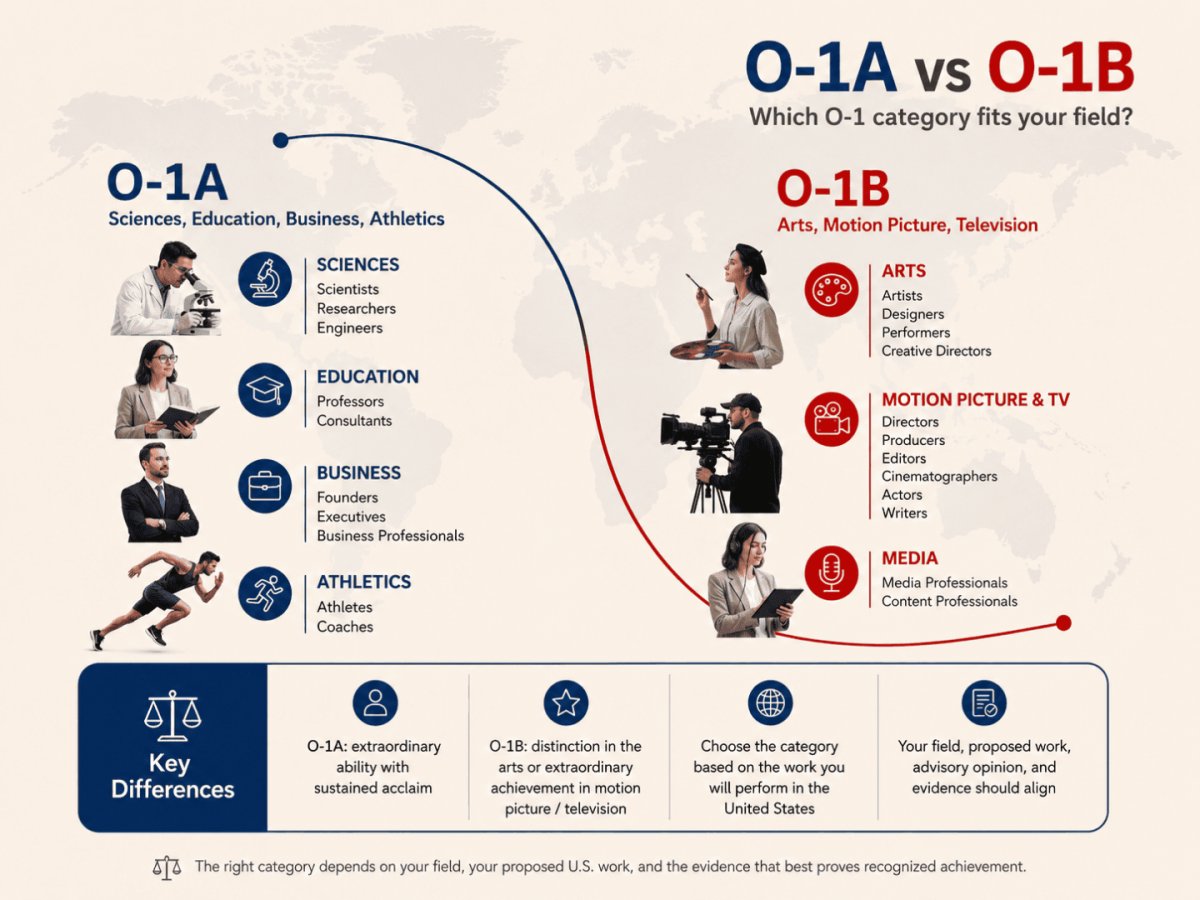
O-1A vs. O-1B: The Key Differences
The core O-1A vs O-1B distinction is field-based, but the practical difference goes deeper. The petition must align the candidate’s field, proposed work, advisory opinion, and supporting evidence into one coherent theory of extraordinary ability or achievement.
| Issue | O-1A | O-1B |
|---|---|---|
| Covered fields | Sciences, education, business, athletics | Arts, motion picture, television |
| Typical profiles | Researchers, founders, executives, athletes, technical experts | Artists, designers, performers, producers, directors, media professionals |
| Main standard | Extraordinary ability with sustained acclaim | Distinction in the arts or extraordinary achievement in MPTV |
| Evidence style | Awards, publications, judging, original contributions, critical roles, salary | Reviews, major productions, press, leading roles, commercial success, expert letters |
| Common challenge | Showing the person is extraordinary, not merely experienced | Showing distinction or achievement beyond ordinary creative work |
For many candidates, the hardest part is not collecting documents. The hardest part is deciding whether those documents prove business or technical acclaim, artistic distinction, or motion picture and television achievement.
- Choose O-1A when the strongest evidence is tied to science, education, business, athletics, innovation, leadership, or technical impact.
- Choose O-1B arts when the strongest evidence is tied to artistic recognition, creative reputation, performances, exhibitions, design, or cultural contribution.
- Choose O-1B motion picture or television when the U.S. work and evidence are tied to production work, credited roles, industry recognition, and screen-based projects.
These categories can overlap in real life, but USCIS still expects a legally coherent petition. A creative entrepreneur may have both brand-building evidence and business leadership evidence, but the petition should explain which side carries the case.
Not sure whether your profile fits O-1A or O-1B?
Your category choice can affect the entire petition strategy. Before filing, it is important to review your proposed U.S. work, your strongest evidence, and whether your achievements are better framed under business, science, arts, or motion picture and television standards.
Which O-1 Category Applies to You?
Some candidates fit neatly into one category. Others need a closer analysis because their work crosses between technology, entrepreneurship, entertainment, design, and media. For those candidates, the right question is not “What is my title?” but what work will I perform in the United States and what evidence best proves my reputation.
If you are a startup founder
A startup founder often fits O-1A when the evidence centers on business leadership, innovation, funding, product development, market traction, or industry recognition. The petition should show extraordinary ability in business or technology and a U.S. role connected to that expertise.
Founder cases are not won by saying “I started a company.” A stronger case explains why the founder’s work is exceptional, how the company or product gained recognition, and how the person’s role shows critical leadership or original contribution of major significance.
If you are a designer or creative professional
Designers can be difficult because design can be artistic, commercial, technical, or strategic. A fashion designer, UX designer, creative director, and industrial designer may all use different evidence, even if they all use the word designer and all claim creative distinction.
If the work is primarily artistic or creative, O-1B may be the stronger fit. If the work is primarily tied to product strategy, technology, user experience systems, or business growth, O-1A may be more appropriate depending on the evidence. The best category depends on the real nature of the work and how the field recognizes excellence.
If you work in film, television, or streaming media
Professionals working in film, television, or certain streaming productions may fall under O-1B motion picture and television. This can include directors, producers, editors, cinematographers, actors, writers, and other key production professionals when the role and evidence support extraordinary achievement in screen-based work.
The rise of digital platforms can make the analysis more complex. A creator may have strong online metrics, commercial partnerships, and media recognition, but the petition still needs to explain whether the U.S. work is best treated as arts-based work, motion picture or television work, or another classification theory.
If your role combines business and creative work
Many modern professionals are hybrid profiles. A founder may also be a public speaker; a designer may also lead a company; a creator may also run a media business. In these cases, the petition should avoid confusion by choosing one primary legal theory and organizing the record around the strongest classification path.
Practical takeaway: A hybrid profile is not a problem by itself. The risk comes when the petition presents business, art, media, and technology evidence without explaining which O-1 standard applies and why that standard is satisfied.
How the O-1 Petition Works
After the category is selected, the O-1 petition is usually filed on Form I-129 by a U.S. employer, U.S. agent, or qualifying petitioner. The petition should document the beneficiary’s achievements, the proposed U.S. work, and the relationship between the field of acclaim and the offered work.
- Identify the correct O-1 category.
- Confirm the petitioner structure, such as employer or agent.
- Define the U.S. role, project, event, or itinerary.
- Collect evidence that matches the selected standard.
- Obtain the required advisory opinion when applicable.
- Prepare Form I-129 and supporting exhibits.
- File with USCIS and respond to any Request for Evidence if issued.
Petitioner, employer, or agent
An O-1 beneficiary generally cannot self-petition in the same way some immigrant categories allow. The structure must include a proper U.S. petitioner, and for project-based work, an agent structure may be important to connect multiple engagements or employers.
Advisory opinion requirement
Many O-1 petitions require an advisory opinion from an appropriate peer group, labor organization, or management organization. DOS guidance in 9 FAM 402.13 also discusses O visa classification in the consular context. The advisory opinion should align with the selected O-1 category and the beneficiary’s field of work.
Evidence strategy by category
O-1A and O-1B petitions may use similar types of evidence, such as press, awards, expert letters, or high-level roles. But the argument changes depending on whether the case is proving extraordinary ability in business or science, distinction in the arts, or extraordinary achievement in motion picture and television.
Common Mistakes When Choosing Between O-1A and O-1B
One of the most common mistakes is treating the O-1 as a general talent visa. The O-1 is not only about being talented; it is about proving that the person meets a specific legal standard within a specific O-1 category.
- Choosing O-1B just because the person works in a creative industry.
- Choosing O-1A just because the person owns or operates a business.
- Ignoring the difference between arts and motion picture or television work.
- Submitting strong evidence without explaining why it satisfies the selected standard.
- Using job titles instead of analyzing the actual U.S. work.
- Failing to align the advisory opinion with the petition theory.
Another mistake is assuming that a strong resume automatically creates a strong O-1 case. USCIS is looking for organized proof of recognition, not just a list of accomplishments. The petition should connect each exhibit to the legal criteria being claimed.
For related evidence planning, you can also review our guide on O-1 visa criteria and the types of evidence USCIS wants. If your long-term goal is permanent residence, our article on the EB-1A extraordinary ability green card may also help you understand how temporary O-1 strategy can connect to future planning.
The Right Category Shapes the Whole Case
The difference between O-1A and O-1B is not just a label. It affects the legal standard, evidence strategy, advisory opinion, petitioner framing, and how USCIS understands your professional identity and your proposed U.S. work.
If your record is strong but your field is hybrid, category selection becomes especially important. Before filing, review whether your evidence is stronger for O-1A extraordinary ability, O-1B arts distinction, or O-1B motion picture and television achievement.
Need help choosing between O-1A and O-1B?
For a personalized evaluation of your U.S. immigration case, get in touch with our team. We will review your field and evidence, assess the strongest O-1 category, and recommend the strategy that fits your circumstances best.
Phone: (+1) 862-799-2200
Email: info@gozellaw.com
Legal Disclaimer
This article is provided for general informational purposes only and does not constitute legal advice. Every immigration case has unique circumstances. For legal guidance specific to your situation, we recommend consulting with an experienced immigration attorney. The information in this article reflects laws and policies as of the publication date; subsequent changes may affect its accuracy.
Sources
Frequently Asked Questions About O-1A & O-1B Visas
Neither category is automatically easier. The better category is the one that matches your field and U.S. work and allows your strongest evidence to prove the correct legal standard.
It depends on the type of design work. A designer may fit O-1B if the work is primarily artistic or creative, but may fit O-1A if the strongest evidence is tied to business, technology, product innovation, or strategic leadership.
Yes, a startup founder may qualify for O-1A if the record shows extraordinary ability in business, technology, science, or another covered O-1A field. The case should prove more than ownership; it should show recognized achievement and significant professional impact.
Some people may have evidence that touches both categories, especially hybrid founders, designers, media entrepreneurs, or creators. But the petition should usually present one primary classification theory and a clear evidence framework.
No. O-1B can include arts, motion picture, and television work, and the arts category can be broad. Still, the petition must show that the proposed work and evidence support an O-1B theory and recognized distinction or achievement.
There are no comments yet. Be the first to comment!