F2A Visa Guide: Eligibility, I-130, I-485 & Timelines
Index
- Key Takeaways
- What the F2A Category Actually Covers
- Six Questions That Decide Your F2A Path
- Question 1: Is the Beneficiary Inside or Outside the United States?
- Question 2: If Inside the U.S., Can They Actually Adjust Status?
- Question 3: How Close Is the Child to Turning 21?
- Question 4: Will the Petitioner Naturalize, or Could the Situation Change?
- Question 5: Does the Petitioner Meet the Income Requirement?
- Question 6: Is the Relationship Evidence Strong Enough?
- What “Current” Actually Means for Your Timeline
- What the Process Costs and How Long It Takes
- Start With Your Own Facts
- Sources
An F2A case is two waits, not one. First you wait for USCIS to decide the petition. Then you wait for a visa number to reach your place in line. Most guides describe that as a single timeline and tell you to watch the Visa Bulletin.
That advice is incomplete, and for some families it is actively harmful. The Visa Bulletin tells you whether the category is open. It tells you nothing about whether you personally qualify to use it. Every month, spouses of green card holders read that F2A is current, file an application they were never eligible to file, and pay for the mistake with a denial and, in some cases, a removal referral.
This guide is organized around six questions rather than around the process. Answer them in order and you will know which path applies to your family, what can disqualify you before you file, and where the real decisions sit.
Key Takeaways
- Visa availability and personal eligibility are separate gates. A category listed as current in the Visa Bulletin says nothing about whether a specific beneficiary is permitted to file.
- F2A is stricter than an immediate relative case on unlawful presence. A spouse of a U.S. citizen can generally adjust status despite an overstay. A spouse of a green card holder usually cannot. This single difference decides many F2A cases.
- Filing early under the Dates for Filing chart does not protect a child’s age. Since August 15, 2025, USCIS calculates CSPA age using the Final Action Dates chart. Families who assume an early filing locks the age are working from guidance that is no longer current.
- If the petitioner naturalizes, the spouse’s case converts automatically. No new petition is required. For children, the upgrade is not always an improvement, and in one situation it removes a benefit the family had.
- A child who marries loses F2A and F2B eligibility entirely. A lawful permanent resident cannot petition a married son or daughter in any category.
- Unlike immediate relative cases, F2A allows derivative beneficiaries. A spouse’s own children can often be included on the spouse’s case. That benefit disappears the moment the petitioner naturalizes.
What the F2A Category Actually Covers
F2A is the first subcategory of the family second preference. It covers two groups: the spouse of a lawful permanent resident, and the unmarried child under 21 of a lawful permanent resident. The petitioner files Form I-130, and the date USCIS properly receives it becomes the priority date.
Unlike immediate relatives of U.S. citizens, F2A is subject to annual numerical limits. Congress sets a floor for the entire second preference and allocates the large majority of those numbers to F2A, with most of that allocation exempt from the usual per-country ceiling. That structural detail is why F2A has historically moved faster than every other family preference category, and why it periodically reaches current status while F2B, F3 and F4 remain years behind.
Who Counts as a Spouse or Child
The marriage must be legally valid where it took place and must be genuine rather than entered into for immigration purposes. Same-sex marriages qualify on the same terms as any other.
For children, the category reaches biological children, adopted children who meet the statutory adoption requirements, and stepchildren where the marriage creating the stepchild relationship occurred before the child turned 18. That age-18 cutoff is fixed and frequently missed. A stepchild relationship formed after the child’s eighteenth birthday does not qualify, regardless of how the family has actually lived.
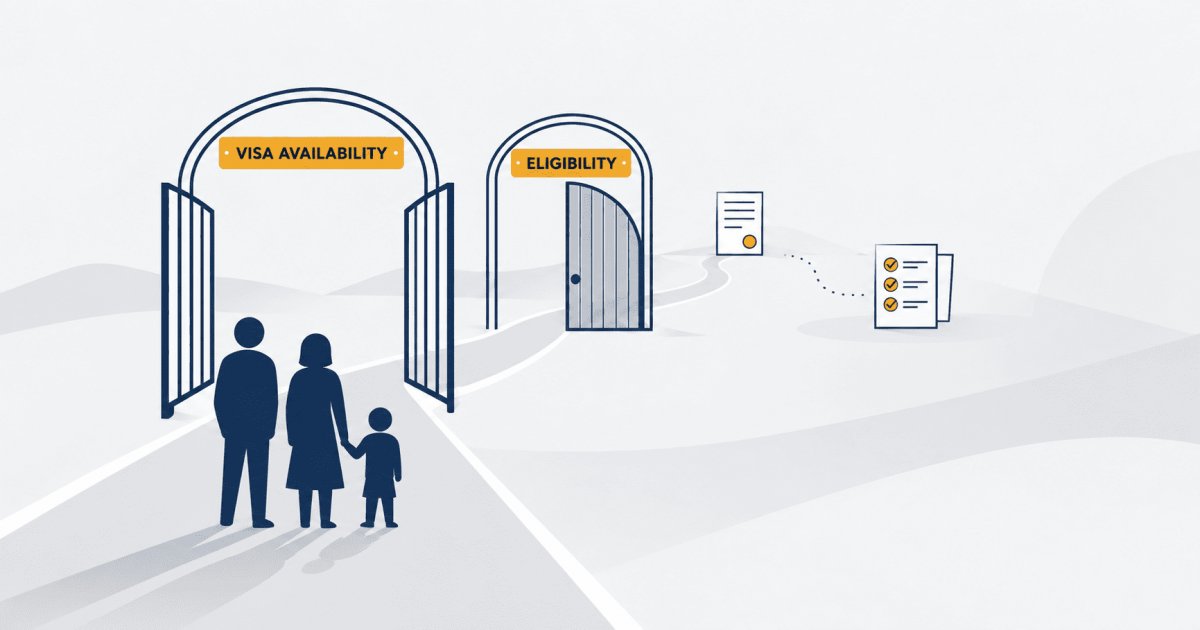
Two Gates, Not One
Everything that follows rests on a distinction worth stating plainly. Gate one is visa availability, controlled by the Visa Bulletin and shared by everyone in the category. Gate two is personal eligibility, controlled by how the beneficiary entered the country, what status they have held, and whether the relationship still qualifies.
Gate one opens and closes for everybody at once. Gate two is individual, and no bulletin will ever tell you where you stand on it.
Six Questions That Decide Your F2A Path
Work through these in order. Each one points to a section below.
- Is the beneficiary inside or outside the United States?
- If inside, can they lawfully adjust status?
- How close is the child to turning 21?
- Will the petitioner naturalize, or could the family situation change?
- Does the petitioner meet the income requirement?
- Is the relationship evidence strong enough?
You do not need to read this guide sequentially. Find the question where your case is uncertain and start there.
Question 1: Is the Beneficiary Inside or Outside the United States?
This determines the entire procedural shape of the case.
Inside the United States: Adjustment of Status
A beneficiary who is physically present in the United States and eligible may file Form I-485 to become a permanent resident without leaving the country. When the category is open under the chart USCIS has designated for that month, the I-130 and I-485 can be filed together in one package.
Concurrent filing carries real advantages. The beneficiary can request employment authorization and advance parole alongside the I-485, which means the ability to work and, with caution, to travel while the case is pending. The green card is issued without an overseas interview.
Outside the United States: Consular Processing
A beneficiary abroad waits for the I-130 to be approved, then for the case to move to the National Visa Center, then completes Form DS-260, submits civil documents and the affidavit of support, attends a medical examination with a panel physician, and interviews at a U.S. consulate. On approval, the immigrant visa is placed in the passport and permanent residence is granted at the port of entry.
Consular processing is slower on paper and has no work permit attached during the wait. For a beneficiary who is already abroad, however, it is usually the only route, and it avoids the eligibility problems described in the next section entirely.
Question 2: If Inside the U.S., Can They Actually Adjust Status?
This is the question that decides the most F2A cases, and it is the one that almost no general guide answers.
The Lawful Entry Requirement
Adjustment of status requires that the beneficiary was inspected and admitted or paroled into the United States. Someone who entered without inspection has not met that requirement and cannot adjust, no matter how long they have lived here, how strong the marriage is, or how current the category appears in the Visa Bulletin.
This is a threshold condition, not a discretionary factor. It is not cured by a sympathetic case, U.S. citizen children, or an approved I-130.
Why F2A Is Stricter Than a U.S. Citizen’s Petition
Here is the distinction that catches families off guard, and it is the single most important paragraph in this guide.
The immediate relative of a U.S. citizen benefits from an exemption that preference beneficiaries do not get. A U.S. citizen’s spouse who entered lawfully but overstayed a visa, or worked without authorization, can generally still adjust status inside the country. An F2A beneficiary in the identical situation usually cannot. Preference applicants must ordinarily have maintained lawful status continuously and must be in lawful status at the time of filing.
The Narrow 245(i) Exception
A limited grandfathering provision allows some people who would otherwise be barred to adjust anyway. It generally requires that a qualifying immigrant petition or labor certification was filed on the applicant’s behalf on or before April 30, 2001, with an additional physical presence requirement for filings made after January 14, 1998, plus a statutory penalty fee at the time of adjustment.
The provision is real and it still helps people. It is also narrow, heavily fact-dependent, and commonly misremembered. The qualifying petition does not have to be the one you are using now, and it does not have to have been approved. If anyone in the family was the subject of a petition or labor certification filed around that era, find the paperwork before assuming adjustment is unavailable. Have counsel evaluate it rather than deciding on your own reading.
If Adjustment Is Off the Table
The alternative is consular processing abroad. For a beneficiary who has accrued significant unlawful presence, departing the United States triggers a multi-year bar on returning, which turns a paperwork problem into a years-long separation.
The tool built for this situation is the provisional unlawful presence waiver, Form I-601A. It allows an eligible applicant to seek a decision on the waiver before leaving the country, so that the departure and consular interview happen with the waiver already approved. The standard requires proving extreme hardship to a qualifying relative, and a lawful permanent resident spouse can serve as that qualifying relative, which matters directly in F2A cases.
Waiver practice is document-intensive and the hardship standard is demanding. This is not a filing to attempt without representation.
Not sure whether your spouse can adjust status inside the U.S.?
Send us the entry history, the current status, and the petition dates. We will tell you which route is actually available before you spend a filing fee finding out.
Question 3: How Close Is the Child to Turning 21?
An F2A child who reaches 21 before the case concludes ordinarily loses the category. The Child Status Protection Act exists to prevent that where the delay was the government’s.
How the Calculation Works
CSPA age is the child’s actual age when a visa becomes available, minus the time the I-130 was pending with USCIS. If the result is under 21, the child keeps F2A classification. The child must also seek to acquire permanent residence within one year of that availability, ordinarily by filing the I-485 or taking the equivalent step in consular processing.
The August 2025 Change That Catches F2A Families
Which chart establishes “availability” changed recently, and most published guidance has not caught up.
From February 2023, USCIS used the Dates for Filing chart, which let many children lock in a favorable age earlier. On August 8, 2025, USCIS reversed that policy. Effective August 15, 2025, a visa becomes available for CSPA purposes based on the Final Action Dates chart, aligning USCIS with the State Department. Applications already pending before that date continue under the earlier policy.
Any article telling you that filing early protects your child was accurate in 2024 and is wrong today. If you have a child within a few years of 21, run the calculation on the current standard and confirm it with counsel before relying on a filing date.
At 21, and at Marriage
If the child ages out despite CSPA, the petition converts automatically to F2B, the category for unmarried sons and daughters 21 and over of permanent residents. The original priority date is retained. No new I-130 is required. The queue, however, is dramatically longer.
Marriage is different, and it is final. A lawful permanent resident cannot petition a married son or daughter in any category. If an F2A or F2B beneficiary marries while the petitioner is still a green card holder, the petition is revoked and the priority date goes with it. If the petitioner has already naturalized, the case converts to F3 instead. The order of those two events decides whether a decade of waiting survives.
Children of the F2A Spouse
This benefit is specific to the preference categories and is routinely overlooked. An F2A spouse may bring their own children along as derivative beneficiaries on the spouse’s case, without separate petitions. Immediate relative cases have no derivatives at all.
Where the marriage occurred before a child turned 18, that child is also a direct F2A stepchild of the petitioner and can have an I-130 of their own. Filing both ways is often the safer approach, and the reason becomes clear in the next section.
Question 4: Will the Petitioner Naturalize, or Could the Situation Change?
The Automatic Upgrade
When the petitioner naturalizes, an F2A spouse case converts automatically to immediate relative. The numerical limit disappears, the priority date stops mattering, and the visa is immediately available. No new petition is needed, though USCIS or the National Visa Center should be notified with proof of naturalization so the record is updated.
For most F2A spouses this is the single largest available improvement, and it is worth tracking the petitioner’s naturalization eligibility from the start of the case rather than treating it as a separate project.
When the Upgrade Is Not Automatically Better
Two situations run the other way.
First, derivative children lose their derivative status on the upgrade. Immediate relative cases carry no derivatives. Children who were riding along on the spouse’s F2A case need their own petitions, and they only qualify as stepchildren of the new citizen if the marriage predated their eighteenth birthday. A naturalization that helps the spouse can strand the children.
Second, a child who has already converted to F2B would ordinarily convert again to F3 when the petitioner naturalizes. In some years and for some countries, F3 moves more slowly than F2B. The law permits an F2B beneficiary to opt out of that conversion and remain in F2B. It is a written election, and it is only worth making after comparing the two categories for that country.
If the Petitioner Dies, the Marriage Ends, or There Is Abuse
Divorce terminates a spousal petition. There is no remedy for that.
Death is different. A surviving beneficiary who resided in the United States when the petitioner died, and continues to reside here, may be able to have the petition continue under the survivor provision of the immigration statute. Separately, humanitarian reinstatement may be available for an approved petition. Both require prompt action.
Where the petitioner has been abusive, an abused spouse or child of a lawful permanent resident may self-petition using Form I-360 under the Violence Against Women Act, without the abuser’s knowledge, participation, or consent. This is confidential by statute and applies regardless of gender.
Question 5: Does the Petitioner Meet the Income Requirement?
The petitioner must file Form I-864, a legally enforceable contract with the U.S. government, and demonstrate income at or above a threshold tied to the federal poverty guidelines for the household size. Active-duty military petitioners sponsoring a spouse or child are held to a lower threshold.
Two mechanics matter more than the number itself. Household size is larger than most petitioners assume: it includes the petitioner, their dependents, the intending immigrants, any derivatives, and anyone previously sponsored on a still-binding affidavit. And where income falls short, a joint sponsor can cover the gap. A joint sponsor must be a citizen or permanent resident, at least 18, domiciled in the United States, and must meet the threshold independently. Assets can sometimes substitute for income, at a multiple that depends on the relationship.
The thresholds are republished annually, so verify the current figures rather than relying on a number from an article. A deficient affidavit is one of the most common reasons an otherwise strong F2A case stalls.
Question 6: Is the Relationship Evidence Strong Enough?
The I-130 proves a relationship, nothing more. For marriage cases, the standard is that the marriage is bona fide, meaning entered into to build a life together rather than to obtain an immigration benefit.
Adjudicators look for evidence that the couple has combined their lives: joint leases or deeds, joint accounts and financial obligations, insurance and beneficiary designations, tax filings, correspondence to a shared address, and children in common. Photographs and affidavits help but rarely carry a file on their own.
Certain patterns draw closer review. A short marriage, a significant age gap, limited cohabitation, a prior removal proceeding, or a previous petition for a different spouse can all lead to a request for evidence or a separate interview in which the spouses are questioned apart. None of these makes a marriage suspect on its own, and each is answerable with documentation prepared in advance.
What “Current” Actually Means for Your Timeline
The Visa Bulletin is published monthly and carries two charts. Confusing them is the most common error in family-based planning.
Dates for Filing (Chart B) indicates when applicants may submit their applications. Final Action Dates (Chart A) indicates when a green card can actually be approved and issued. Both matter, and they do different work.
Adjustment applicants can only use Chart B in a given month if USCIS authorizes it. That authorization is announced separately each month and is not automatic. Applicants abroad are generally invited to submit documents to the National Visa Center on Chart B, but no immigrant visa is issued until Chart A is current.
Dates can also move backward. Retrogression occurs when demand outruns supply and the cutoff date is pulled back. A pending I-485 is not lost when this happens; it simply cannot be approved until the date becomes current again. Employment authorization and advance parole remain renewable, subject to the filing timing warning above.
Because F2A moves, and because its movement is not predictable from one month to the next, we publish a breakdown of each month’s Visa Bulletin as it is released. This guide deliberately contains no cutoff dates, so that nothing in it goes stale. For the current month’s figures, use the Visa Bulletin itself or our monthly analysis.
What the Process Costs and How Long It Takes
Three clocks run in an F2A case, and only the first is within anyone’s control.
Clock one is USCIS adjudication of the I-130, which depends on the service center and its current workload. Clock two is visa availability, driven by demand across the whole category and by the per-country limits. Clock three is the final step, either adjustment of status or consular processing, which depends on interview scheduling and background checks.
When the category is open and the beneficiary is eligible to adjust, clocks one and three can overlap through concurrent filing. That overlap is the only meaningful acceleration available in this category. There is no premium processing for a family-based immigrant petition.
On cost, expect the government filing fees for the petition and the final application, biometrics where applicable, the medical examination, translations, and the immigrant visa and affidavit of support fees on the consular route. Fee amounts change and have changed recently. Confirm current figures on the USCIS fee schedule the day you file, because an incorrect payment produces a rejection rather than a correction notice.
Start With Your Own Facts
The Visa Bulletin describes a queue. It does not describe your family. Whether an F2A case succeeds usually turns on facts that were fixed years before the petition was filed: how the beneficiary entered, what status they have held, when a marriage took place relative to a child’s eighteenth birthday, and how close that child is to 21.
Gather four things before you do anything else. The beneficiary’s entry record and current status. The dates of every marriage in the family. Each child’s date of birth. The petitioner’s date of permanent residence, which sets their naturalization timeline. Those four items will tell you more about your case than any published processing time.
Gozel Law Firm PC handles family-based petitions and the problems that develop around them, including adjustment eligibility analysis, waiver strategy, and action when a case sits at USCIS longer than it reasonably should. We will tell you when a filing is straightforward, and we will tell you when it is not.
Ready to start an F2A case, or stuck in one?
We will review the entry history, the priority date, each child’s age against the current CSPA standard, and the petitioner’s naturalization timeline, then tell you which path is actually open to your family.
Phone: +1 (862) 799-2200 | Email: info@gozellaw.com
Legal Disclaimer
This article is provided for general informational purposes only and does not constitute legal advice. Every immigration case has unique circumstances. For legal guidance specific to your situation, we recommend consulting with an experienced immigration attorney. The information in this article reflects laws and policies as of the publication date; subsequent changes may affect its accuracy.
Sources
Verified as of September 15, 2026. Immigration rules change frequently. Confirm current figures against the primary sources below before acting.
- U.S. Citizenship and Immigration Services — Form I-130, Petition for Alien Relative
- U.S. Citizenship and Immigration Services — Form I-485, Application to Register Permanent Residence or Adjust Status
- U.S. Citizenship and Immigration Services — Form I-864, Affidavit of Support Under Section 213A of the INA
- U.S. Citizenship and Immigration Services — Form I-601A, Application for Provisional Unlawful Presence Waiver
- U.S. Citizenship and Immigration Services — Form I-360, Petition for Amerasian, Widow(er), or Special Immigrant
- U.S. Citizenship and Immigration Services — Child Status Protection Act (CSPA)
- U.S. Citizenship and Immigration Services — USCIS Updates Policy on CSPA Age Calculation (August 8, 2025; effective August 15, 2025)
- USCIS Policy Manual — Volume 7, Part A, Chapter 7: Child Status Protection Act
- U.S. Department of State — Visa Bulletin
- U.S. Citizenship and Immigration Services — Adjustment of Status Filing Charts from the Visa Bulletin
- Federal Register — Removal of the Automatic Extension of Employment Authorization Documents, 90 FR 48799 (October 30, 2025)
Frequently Asked Questions About F2A
Yes, when a visa number is considered immediately available under the chart USCIS has designated for that month and the beneficiary is otherwise eligible to adjust status. Concurrent filing also allows the employment authorization and advance parole requests to go in with the package.
Only with an approved employment authorization document, which is requested alongside a pending I-485. A pending I-130 alone confers no right to work. Beneficiaries abroad have no work authorization during the wait.
Not through adjustment of status, absent a narrow grandfathering exception. The route is consular processing abroad, which for someone with significant unlawful presence usually requires a provisional waiver approved before departure. Get an individual assessment before anyone leaves the country.
Run the CSPA calculation first, using the Final Action Dates standard now in effect. If the adjusted age is under 21 and the child seeks permanent residence within one year of availability, F2A classification is preserved. If not, the petition converts to F2B with the original priority date intact.
The spouse’s case converts automatically to immediate relative and the waiting line disappears. Check the effect on any derivative children before treating the upgrade as unambiguously good news.
Generally yes, as derivatives on the F2A spouse’s case. Where the marriage occurred before the child turned 18, a separate stepchild petition is also possible and is often worth filing as a backstop.
A pending I-485 remains pending and is not denied. USCIS simply cannot approve it until the priority date is current under the Final Action Dates chart. Work and travel authorization remain renewable, but renewals must now be filed early because the automatic extension no longer applies.
There are no comments yet. Be the first to comment!