How to Get Strong EB-2 NIW Recommendation Letters
Index
- Why Recommendation Letters Matter in an EB-2 NIW Petition
- What USCIS Actually Looks For in NIW Support Letters
- Independent vs. Dependent Recommenders: Which Is Better?
- Who Should You Ask for an EB-2 NIW Recommendation Letter?
- Give Every NIW Recommendation Letter a Different Evidentiary Job
- What Should a Strong EB-2 NIW Recommendation Letter Say?
- Avoid Boilerplate Language and Repetitive Letters
- How to Prepare Your Recommenders
- Build a Recommendation Letter Strategy
- Sources
Strong EB-2 NIW recommendation letters do more than say that you are talented, accomplished, or respected in your field. Their real value is evidentiary: a well-prepared letter can explain what you have done, why your work matters, how the recommender knows those facts, and why your past record supports your ability to advance the proposed endeavor described in your National Interest Waiver petition.
This distinction is important because USCIS does not decide an NIW case by counting impressive titles or favorable adjectives. The agency evaluates the petition as a whole under the three-part framework from Matter of Dhanasar. Recommendation letters may support that analysis, particularly when they provide specific examples, credible expert context, and facts that can be corroborated elsewhere in the record.
This guide explains how to build a coordinated EB-2 NIW recommendation letter strategy, how independent and dependent recommenders differ, who to ask, what each letter should accomplish, how to avoid repetitive boilerplate, and how to make several letters work together instead of repeating the same biography.
Why Recommendation Letters Matter in an EB-2 NIW Petition
An EB-2 National Interest Waiver allows a qualifying applicant to request a waiver of the usual job-offer and labor-certification requirements. Before USCIS grants that waiver, the applicant must qualify for the underlying EB-2 classification and satisfy the three-prong test established in Matter of Dhanasar.
For a broader explanation of the classification itself, our EB-2 NIW Green Card guide explains the advanced-degree and exceptional-ability pathways, self-petitioning, and the overall NIW process.
Recommendation letters can help USCIS understand evidence that may otherwise appear disconnected. A publication list shows that articles exist. A patent shows that intellectual property was created. A project record shows that work was performed. A strong expert letter may add context by explaining why those accomplishments matter, what role the applicant actually played, and how the record relates to the future endeavor.
| Dhanasar Issue | What USCIS Is Evaluating | How a Recommendation Letter May Help |
|---|---|---|
| Prong One | Whether the proposed endeavor has substantial merit and national importance | An expert may explain the broader scientific, economic, technological, health, educational, or industry significance of the specific endeavor. |
| Prong Two | Whether the applicant is well positioned to advance the endeavor | A recommender may describe past achievements, technical contributions, leadership, implementation results, adoption, research impact, or other evidence showing the applicant can execute the proposed work. |
| Prong Three | Whether waiving the job offer and labor certification requirements would benefit the United States | In appropriate cases, a knowledgeable stakeholder may explain why flexibility, urgency, cross-institutional work, entrepreneurship, or broader U.S. needs support the requested waiver. |
The full legal test is more detailed than a recommendation-letter strategy. Our Dhanasar three-prong guide addresses the legal standard separately.
A recommendation letter should have an evidentiary job. If you cannot identify what fact, legal issue, or part of the proposed endeavor a letter helps establish, adding another letter may simply add pages rather than strength.
What USCIS Actually Looks For in NIW Support Letters
The current USCIS EB-2 guidance explains that letters may be persuasive when experts have first-hand knowledge of the applicant's achievements, describe those achievements, and provide specific examples showing why the applicant is well positioned to advance the proposed endeavor. USCIS also evaluates the totality of the evidence, which means no recommendation letter should be treated as a substitute for the underlying documentation.
USCIS reinforced this evidence-focused approach in its January 2025 NIW guidance update, which specifically addressed the evaluation of support letters and other evidence used to establish that an applicant is well positioned to advance an endeavor.
In practical terms, a persuasive NIW letter usually does four things well:
- Establishes the recommender's credibility. The writer explains relevant expertise, position, experience, or other qualifications that allow the writer to evaluate the applicant's work.
- Explains the basis of knowledge. The letter makes clear whether the writer supervised the applicant, collaborated with the applicant, reviewed or cited the applicant's work, adopted a method or technology, observed a project, or knows the work through another identifiable professional connection.
- Provides concrete facts. Specific projects, contributions, technical results, publications, deployments, patents, citations, products, policies, contracts, or measurable outcomes are stronger than generalized praise.
- Connects past evidence to future execution. The strongest letters explain why the applicant's record makes the proposed future endeavor credible.
| Weak Statement | Stronger Evidentiary Approach |
|---|---|
| "She is one of the best professionals in her field." | Identify the specific work the recommender evaluated, what distinguished it, and what result or use followed. |
| "His research is nationally important." | Explain what the research addresses, who may benefit, and why its prospective impact extends beyond one employer or project. |
| "She will certainly succeed in the United States." | Describe past progress, available resources, collaborations, implementation experience, or other facts showing she is well positioned. |
| "His work has received international recognition." | Identify independent citations, adoption, awards, standards use, media coverage, licensing, invited activity, or other evidence supporting the claim. |
Independent vs. Dependent Recommenders: Which Is Better?
NIW applicants often hear that every letter should come from an "independent expert." That oversimplifies the issue. USCIS does not create a formal scoring system in which an independent recommender automatically carries more weight than a supervisor, advisor, colleague, or collaborator. The more useful question is what the particular writer can credibly establish.
A dependent or closely connected recommender may have direct knowledge that an outside expert cannot provide. A doctoral advisor can explain the applicant's actual contribution to a research program. A supervisor may document responsibility for an important technical deployment. A business partner may describe the applicant's role in moving an innovation from planning to implementation.
An independent expert serves a different purpose. That person may be especially useful when the petition needs evidence that recognition or interest extends beyond the applicant's immediate professional circle. The expert might know the applicant's work through publications, citations, conference activity, adoption, technical use, industry exposure, standards work, or another professional channel even if the two have never worked together.
| Recommender Type | Strongest Use | Common Risk |
|---|---|---|
| Advisor or Supervisor | Detailed first-hand account of the applicant's role, technical ability, leadership, and results | The letter may sound like an employment reference if it does not explain broader significance. |
| Collaborator or Client | Evidence of implementation, practical value, project results, adoption, or professional reliance | The letter may focus too heavily on benefits to one organization. |
| Independent Expert | External recognition, field-level significance, independent use or awareness of the applicant's work | A generic letter from a prestigious stranger may carry little value if the basis of knowledge is unclear. |
| Government or Quasi-Governmental Source | Government interest, national priorities, urgency, broader significance, or the applicant's ability to advance a relevant endeavor | The letter is not automatically dispositive and must still contain meaningful facts. |
USCIS specifically notes that letters from interested U.S. government agencies or quasi-governmental entities are not required, but may be helpful depending on their substance. Its government-agency NIW guidance explains that detailed letters can be relevant to national importance, whether the applicant is well positioned, and, in appropriate cases, the balancing analysis.
Who Should You Ask for an EB-2 NIW Recommendation Letter?
Start with the evidence your petition needs, then identify the person best positioned to explain that evidence. Starting with a list of famous people and asking each for a general endorsement usually produces repetitive letters.
When evaluating a potential recommender, ask four questions:
- What does this person know that another recommender cannot explain as well? A useful writer should add a distinct perspective to the record.
- How does this person know the relevant facts? The letter should have a credible basis of knowledge, not merely summarize your CV.
- Can the writer give concrete examples? A recommender who can discuss a specific contribution, adoption, result, or professional interaction is usually more useful than someone who can provide only praise.
- Can the claims be supported elsewhere? Whenever possible, the letter should point toward publications, patents, project records, contracts, citations, funding, reports, metrics, or other objective exhibits.
Prestige can provide context, but prestige is not a substitute for knowledge. A highly recognized professor who knows almost nothing about your work may produce a weaker letter than a less famous specialist who can describe exactly how your contribution affected a project or field.
Give Every NIW Recommendation Letter a Different Evidentiary Job
The most effective strategy is to design the recommendation-letter set before drafting individual letters. Instead of asking every recommender to say that your work is important and that you deserve an NIW, decide what each person is uniquely qualified to establish.
| Evidence Goal | Potential Recommender | What the Letter Should Establish | Possible Supporting Exhibits |
|---|---|---|---|
| Past technical or scholarly impact | Independent field expert | How the applicant's work has been used, cited, adopted, discussed, or recognized outside the applicant's immediate organization | Citations, publications, adoption evidence, conference records, technical reports |
| Ability to execute | Supervisor, advisor, collaborator, or project leader | The applicant's actual responsibilities, problem-solving ability, leadership, technical contribution, and measurable results | Project documents, patents, performance data, grants, deployments, awards |
| Future endeavor | Industry, academic, institutional, or government stakeholder | Why the proposed work addresses a real need and why the applicant's background provides a credible path forward | Research plan, letters of interest, contracts, collaborations, funding, implementation plan |
| Broader U.S. significance | Independent expert or interested stakeholder | Why the specific endeavor may have implications beyond one employer, laboratory, customer, or local project | Government priorities, industry evidence, market data, public-health or technical documentation |
Coordinating Multiple Recommenders
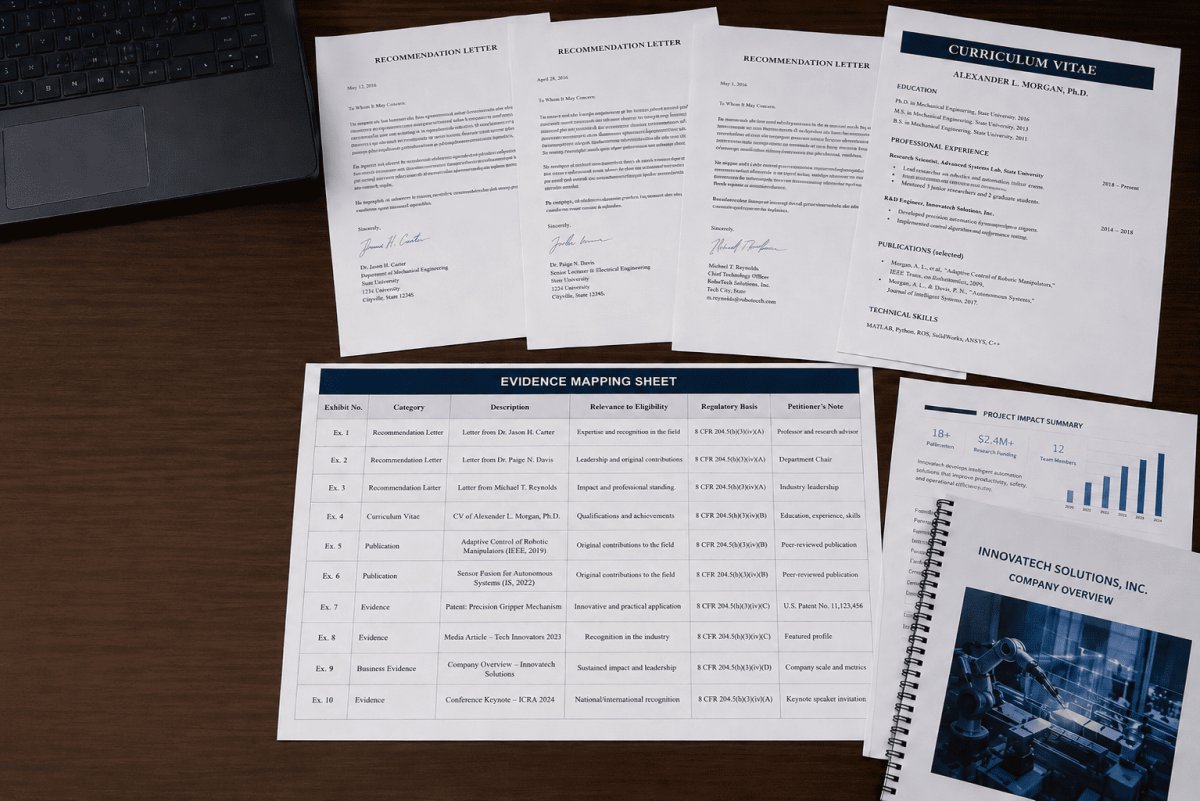
Before drafting, create a simple matrix listing each recommender, the facts the person can verify, the Dhanasar issue those facts relate to, and the exhibits that corroborate the statements. This reduces repetition and exposes evidence gaps early.
For example, if four recommenders all discuss your publications but no one can explain your future implementation plan, the letter package may be unbalanced. If everyone says your endeavor is nationally important but no one provides concrete evidence that you are well positioned to execute it, the petition may still have a Prong Two problem.
This is particularly important in technical cases. Our EB-2 NIW guide for STEM professionals explains why publications, citations, patents, funding, deployments, and expert letters are strongest when they are organized around the proposed endeavor rather than presented as a collection of credentials.
What Should a Strong EB-2 NIW Recommendation Letter Say?
There is no single mandatory template. The content should reflect what the particular writer genuinely knows and why that information matters to the petition. A practical structure may look like this:
- Identify the recommender. State the writer's position, expertise, relevant experience, and qualifications to assess the subject matter.
- Explain the relationship or basis of knowledge. Clarify how the writer knows the applicant or became familiar with the applicant's work.
- Identify the specific contribution. Describe the project, research, technology, business contribution, policy work, clinical activity, or other accomplishment in factual terms.
- Explain why the contribution matters. Provide technical or professional context that an immigration officer may not obtain from the exhibit alone.
- Use concrete examples. Describe adoption, measurable outcomes, citations, implementation, recognition, leadership, or another observable result where applicable.
- Connect the record to the proposed endeavor. Explain why the applicant's prior experience supports the ability to continue or expand the proposed U.S. work.
- Address broader significance when appropriate. If the writer is qualified to do so, explain why the endeavor has implications beyond one employer or client.
- Close with a fact-based assessment. The conclusion should follow from the evidence discussed rather than introduce unsupported superlatives.
Professional letterhead, the recommender's title, institutional affiliation, contact information, signature, and date can help make the professional context clear. They should not, however, be confused with the substance of the evidence. A beautifully formatted generic letter remains a generic letter.
Avoid Boilerplate Language and Repetitive Letters
One of the fastest ways to weaken a recommendation package is to make every letter sound as though it came from the same template. USCIS reviews the record for probative value. Repeating identical conclusions in five signatures does not create five independent facts.
Avoid these common problems:
- Repeating the CV. The officer already has the applicant's resume. The letter should add context, analysis, or first-hand knowledge.
- Using unsupported superlatives. Phrases such as "world-renowned," "exceptional," or "among the best" are less useful when the letter does not explain the factual basis.
- Giving every recommender the same assignment. Multiple letters should expand the record, not duplicate it.
- Discussing the importance of the field instead of the endeavor. Saying that artificial intelligence, medicine, infrastructure, or cybersecurity matters does not by itself establish the national importance of the applicant's specific work.
- Making conclusions without corroboration. Claims about revenue, adoption, citations, job creation, performance improvements, or implementation should be supported where evidence is available.
- Ignoring the future plan. NIW is forward-looking. A letter that describes only past achievements may fail to explain why those achievements show readiness to advance the proposed endeavor.
- Overstating what the recommender knows. A letter should not imply personal knowledge of facts that the writer learned only from materials supplied for the petition.
A January 8, 2026 AAO non-precedent decision illustrates the broader point. The record included support letters and evidence concerning research and citations, but the AAO still concluded that the total record did not sufficiently establish that the petitioner was well positioned under the second Dhanasar prong. A favorable letter therefore does not eliminate the need for a coherent and corroborated evidentiary record.
How to Prepare Your Recommenders
A recommender should not have to reconstruct your NIW case from a long CV. Giving the writer a focused information packet makes it easier to prepare a specific and accurate letter.
Depending on the relationship, that packet may include:
- a short summary of the proposed endeavor;
- your current CV or resume;
- the project, publication, patent, product, or contribution the recommender is being asked to discuss;
- relevant objective evidence, such as citation records, project metrics, adoption evidence, awards, grants, contracts, or technical documentation;
- a brief explanation of the recommender's intended evidentiary role; and
- fact-checking notes for dates, titles, project names, measurements, and other details.
If counsel or the applicant assists with a draft, the recommender should have a genuine opportunity to review it, make corrections, remove statements the writer cannot personally support, and adopt the final text as the writer's own statement. Accuracy matters more than aggressive wording.
Build a Recommendation Letter Strategy
The strongest EB-2 NIW recommendation letters are part of an evidence system. Each writer should have a clear reason for being included, a credible basis for the statements made, and a distinct contribution to the petition's overall theory.
Start by identifying what USCIS needs to understand about your proposed endeavor and your ability to advance it. Then match each issue to the recommender who can explain it most credibly. Finally, connect the letter to objective evidence elsewhere in the filing. This approach helps transform recommendation letters from generalized endorsements into specific, corroborated evidence that supports the legal argument.
Recommendation letters are also only one part of the NIW timeline. If you are planning the filing sequence, premium processing, or the later Green Card stage, our EB-2 NIW processing-times guide explains those issues separately.
Are your EB-2 NIW recommendation letters supporting the right parts of your case?
Contact our team for a personalized review of your proposed endeavor, recommender strategy, expert and support letters, objective evidence, Dhanasar framework, and overall EB-2 NIW petition plan.
Phone: +1 (862) 799-2200 | Email: info@gozellaw.com
Legal Disclaimer
This article is provided for general informational purposes only and does not constitute legal advice. Every immigration case has unique circumstances. For legal guidance specific to your situation, we recommend consulting with an experienced immigration attorney. The information in this article reflects laws and policies as of the publication date; subsequent changes may affect its accuracy.
Sources
- USCIS: Employment-Based Immigration, Second Preference EB-2
- USCIS: Updated Guidance on EB-2 National Interest Waiver Petitions
- USCIS Policy Manual Update: Second Preference Eligibility for National Interest Waiver Petitions
- USCIS: Interested Government Agency Letters in Support of National Interest Waivers
- Matter of Dhanasar, 26 I&N Dec. 884 (AAO 2016)
- Cornell Legal Information Institute: 8 CFR § 204.5
- USCIS AAO Non-Precedent Decision, January 8, 2026
Frequently Asked Questions About EB-2 NIW Recommendation Letters
USCIS does not publish a required number of recommendation letters for a standard NIW petition. The stronger question is whether each letter adds useful evidence. Three distinct, detailed letters may be more useful than six repetitive letters, while another case may benefit from a different mix. The overall record should drive the number.
No personal friendship or employment relationship is required. An independent expert may know your work through publications, citations, professional use, technical review, conference activity, industry adoption, or another credible channel. What matters is that the letter clearly explains how the writer knows the facts being discussed.
Yes. A closely connected recommender may provide valuable first-hand evidence about your role, responsibilities, technical contributions, leadership, or results. The risk is not the relationship itself. The risk is relying exclusively on internal praise without enough independent or objective evidence.
There is no general USCIS rule requiring a particular number of independent letters. Independent experts can be strategically useful when they demonstrate recognition or impact outside your immediate organization, but the letter's specificity, basis of knowledge, and consistency with the underlying evidence remain critical.
A letter may help explain national importance, but USCIS evaluates the totality of the evidence. Objective records showing broader prospective impact, government or industry needs, adoption, technical significance, economic implications, public-health relevance, or similar facts may be important depending on the endeavor.
Usually, that is not necessary. Forcing every writer to address every prong often produces repetitive and unnatural letters. A coordinated strategy may be stronger when different recommenders focus on the facts they are best qualified to explain.
There are no comments yet. Be the first to comment!